
Punjar: wide-eyed madmen stalk the streets pronouncing the end of days, mail-clad priests crush the skulls of heathens underfoot, and timorous virgins are offered up in sacrifice within sooty temples. But even the greatest of shining temples and the strangest of mystery cults don’t dare to challenge the terrifying finality of Death. Until now. In Blades Against Death, the adventurers cross between the realms of the living and the dead, and wager their souls in a desperate bid to steal a soul from Death’s hoary grasp. To win over the God of Dooms, you must be the most daring, stalwart and cunning and – when all else fails – willing to test your blades against Death! A mid-level adventure for the Dungeon Crawl Classics Role Playing Game, Blades against Death offers characters a once in a lifetime escapade. Those that return from the Realms of the Dead will have earned the true title of adventurer, while those that fail will spend eternity in Death’s service.

Run, play or splice up 66 pages of mayhem and weirdness in this Slavic mythic-inspired (with an acid fantasy-twist) mini-sandbox for Labyrinth Lord or the well-aged fantasy rpg of your druthers. Contains: • A 25-site pointcrawl of the otherwordly Slumbering Ursine Dunes region. Beyond the big ticket adventure sites you will find along the way a Polevik-haunted rye field, a Zardoz head-living hermit, bearling pilgrimage site, antediluvian beaver engineers and other assorted madness. • Two separate “dungeons”, the bio-mechanical, lost-in-time Golden Barge and the faction-contested Glittering Tower, with enough detail and portability to be slotted into an existing campaign. • The Chaos Index, a dynamic events system for modeling the mythic weirdness of the Dunes. Actions of the players in the sandbox will escalate or de-escalate the levels of events. • Four competing factions operating inside the Dunes, plus guidelines for their mutual interactions.

This campaign was created as a response to comments from some friends of mine. Though they were avid board game players, they didn’t want to try D&D because it seemed like too much of a time commitment with too many rules to learn before getting started. This campaign uses stripped down characters and a simple campaign, and was made to give them a chance to try it for half an hour on a regular board games night. I’m putting it online in the hopes that other people can do the same with it and expand the community. Inspired by /u/plaintreality of Reddit.

To Kill A King Death to King Ovar the tyrant! Life to law and order! Four characters are charged with a mission so insane, so daring, that terming it an assassination does not do it justice. Are the four volunteers who would lay low King Ovar killers or heroes? If murderers, how are they better than the madman theyre assigned to kill? And even if they are mere assassins, are they determined enough to overcome the Maze of Zayene? Snared in the Wizards Web
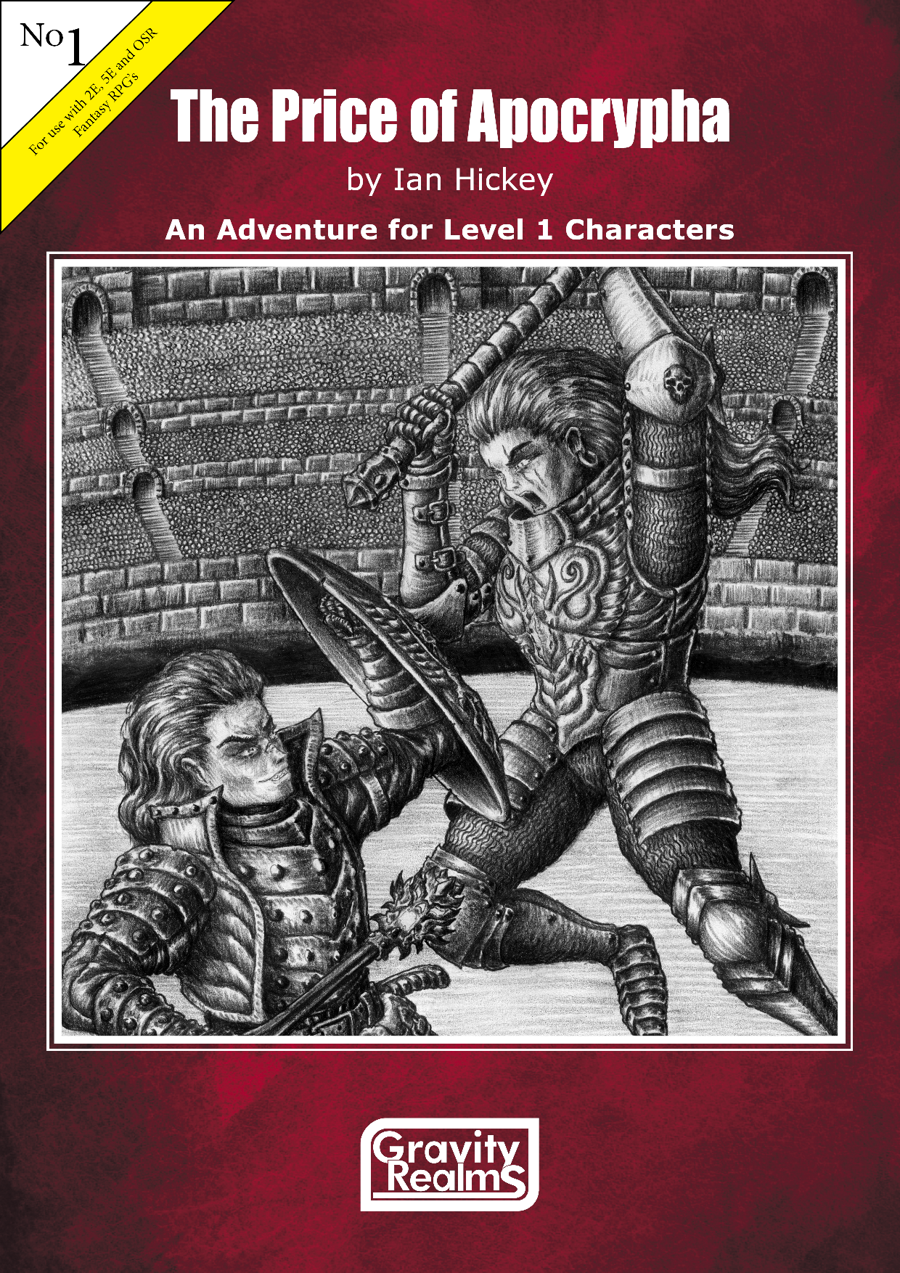
Everyone in the city eagerly anticipates The Arena's opening at the end of every month. This month, an unexpected change to the lineup just days before is rife with rumours! The most feared and respected gladiator in history, Imhullu, the Dragon of Marduk, has issued a challenge to an unknown rival—a fight to the death on charges of heresy. Rumours of insults and slander are spreading throughout the Great Market, though the truth remains inscrutable. The crowds gathered outside The Arena are beyond belief; people must have come from every dimension. Gaining entrance to The Arena is going to be next to impossible. Also, you don't have a ticket! Fortunately for you, you haven't spent your youth in a particularly productive manner! Centred around a gigantic arena full of gladiators, your adventurers must brave the depths of The Pits evading and fighting strange, horrifying creatures, in order to gain entrance. Once inside, they must hold strong against social and political pressures in the hopes of finding a seat in time to watch the main event! But have they gotten themselves caught up in secrets best left alone? There’s only one way to find out!
Ancient port city on the edge of a desert. The city is stratified by social class and some of the slaves have formed a cannibal cult to Kthulhu. City + hexcrawl + dungeon. The Anthropophagi of Xambaala™ takes players into an action-packed realm of adventure: the mythical world of Hyperborea, a sword-and-sorcery campaign setting inspired by the fantastic fiction of Robert E. Howard, H.P. Lovecraft, Clark Ashton Smith, and others. This adventure is inspired by Robert E. Howard’s “The Man-Eaters of Zamboula” and by various short tales of H.P. Lovecraft and Clark Ashton Smith. It is designed for use with Astonishing Swordsmen & Sorcerers of Hyperborea ™(AS&SH™), a role-playing game descended from the original 1974 fantasy wargame and miniatures campaign rules as conceived by E. Gary Gygax and Dave Arneson. AS&SH is compatible with most traditional fantasy role-playing games (c. 1974 to 1999) and their modern simulacra, such as OSRIC™ and Swords & Wizardry™. This work is both a setting and an adventure. The setting describes the town of Xambaala, noting key people, locations, and local lore. The adventure proper provides players with a variety of environments and the several factions fighting over them for their own goals. With a bit of skill and luck, stalwart adventurers may emerge richer and maybe wiser. The situation that will develop in Xambaala will be determined by the players’ choices.

The Lotus Blossom Steppes have long been a land of disjointed tribes, squabbling with one another for central rulership. In the past, great rulers laid claim to the Steppes, bringing the tribes under a single banner for a great purpose—be it under the terrible dictatorship of a half-rakshasa khan or an enlightened visionary khan that leads the tribes beyond the borders of the Steppes. Yet there is great power tucked away behind the tribes’ individual banners. All it takes is an individual with enough ambition and enough power to change the destiny of the Lotus Blossom Steppes... and one ambitious man is on the hunt for the fragmented powers of the NewGod war. Can the PCs put an end to a rising warlord's ambitions, or will the Lotus Blossom Steppes fall again into tribal conflict?

Odyssey of the Dragonlords is heavily inspired by stories from ancient Greek mythology. As we designed the campaign, we sought to include ideas from many different sources: The Odyssey, The Iliad, Jason and the Argonauts, The Oresteia, and others. However, Thylea is not ancient Greece. You will not find Zeus, Athena, or Apollo among the gods. As you explore Thylea, you will encounter familiar tropes, monsters, and treasures from Greek mythology—but the rules are different here. Mortals have only recently come to these lands. The world of Thylea blends high fantasy with the trappings of ancient history. Elves, dwarves, and halflings now live alongside minotaurs, centaurs, and satyrs. Our goal is to make your party feel like heroes from one of the greatest stories ever told—but the ultimate end of that story is entirely within your power. Your players will make choices that forever change the world of Thylea. As the gamemaster, we encourage you to embrace this idea and run with it. How will your players reshape history—and what does it mean to be a hero?
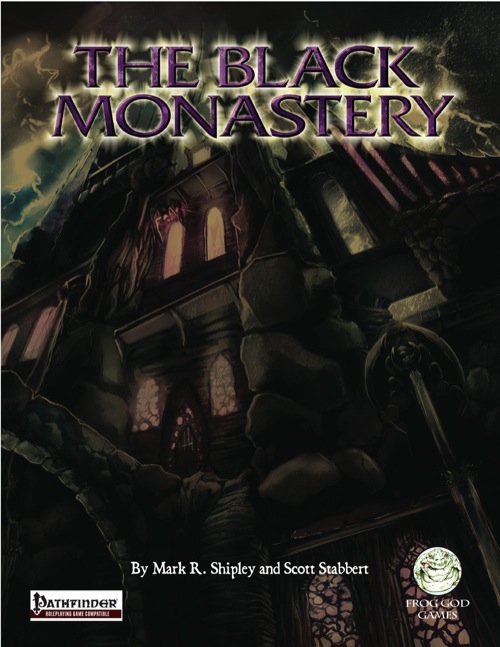
The Legend of the Black Monastery Two centuries have passed since the terrible events associated with the hideous cult known as the Black Brotherhood. Only scholars and story-tellers remember now how the kingdom was nearly laid to waste and the Black Monastery rose to grandeur and fell into haunted ruins. The Brothers first appeared as an order of benevolent priests and humble monks in black robes who followed a creed of kindness to the poor and service to the kingdom. Their rules called for humility and self denial. Other religious orders had no quarrel with their theology or their behavior. Their ranks grew as many commoners and nobles were drawn to the order by its good reputation. The first headquarters for the order was a campsite, located in a forest near the edge of the realm. The Brothers said that their poverty and dedication to service allowed them no resources for more grand accommodations. Members of the Black Brotherhood built chapels in caves or constructed small temples on common land near villages. They said that these rustic shrines allowed them to be near the people they served. Services held by the Brothers at these locations attracted large numbers of common people, who supported the Black Brotherhood with alms. Within 50 years of their first appearance, the Black Brotherhood had a number of larger temples and abbeys around the kingdom. Wealthy patrons endowed them with lands and buildings in order to buy favor and further the work of the Brothers. The lands they gained were slowly expanded as the order’s influence grew. Many merchants willed part of their fortunes to the Black Brotherhood, allowing the order to expand their work even further. The Brothers became bankers, loaning money and becoming partners in trade throughout the kingdom. Within 200 years of their founding, the order was wealthy and influential, with chapters throughout the kingdom and spreading into nearby realms. With their order well-established, the Black Brotherhood received royal permission to build a grand monastery in the hill country north of the kingdom’s center. Their abbot, a cousin of the king, asked for the royal grant of a specific hilltop called the Hill of Mornay. This hill was already crowned by ancient ruins that the monks proposed to clear away. Because it was land not wanted for agriculture, the king was happy to grant the request. He even donated money to build the monastery and encouraged others to contribute. With funds from around the realm, the Brothers completed their new monastery within a decade. It was a grand, sprawling edifice built of black stone and called the Black Monastery. From the very beginning, there were some who said that the Black Brotherhood was not what it seemed. There were always hints of corruption and moral lapses among the Brothers, but no more than any other religious order. There were some who told stories of greed, gluttony and depravity among the monks, but these tales did not weaken the order’s reputation during their early years. All of that changed with the construction of the Black Monastery. Within two decades of the Black Monastery’s completion, locals began to speak of troubling events there. Sometimes, Brothers made strange demands. They began to cheat farmers of their crops. They loaned money at ruinous rates, taking the property of anyone who could not pay. They pressured or even threatened wealthy patrons, extorting money in larger and larger amounts. Everywhere, the Black Brotherhood grew stronger, prouder and more aggressive. And there was more… People began to disappear. The farmers who worked the monastery lands reported that some people who went out at night, or who went off by themselves, did not return. It started with individuals…people without influential families…but soon the terror and loss spread to even to noble households. Some said that the people who disappeared had been taken into the Black Monastery, and the place slowly gained an evil reputation. Tenant farmers began moving away from the region, seeking safety at the loss of their fields. Slowly, even the king began to sense that the night was full of new terrors. Across the kingdom, reports began to come in telling of hauntings and the depredations of monsters. Flocks of dead birds fell from clear skies, onto villages and city streets. Fish died by thousands in their streams. Citizens reported stillborn babies and monstrous births. Crops failed. Fields were full of stunted plants. Crimes of all types grew common as incidents of madness spread everywhere. Word spread that the center of these dark portents was the Black Monastery, where many said the brothers practiced necromancy and human sacrifice. It was feared that the Black Brotherhood no longer worshipped gods of light and had turned to the service of the Dark God. These terrors came to a head when the Black Brotherhood dared to threaten the king himself. Realizing his peril, the king moved to dispossess and disband the Black Brother hood. He ordered their shrines, abbeys and lands seized. He had Brothers arrested for real and imagined crimes. He also ordered investigations into the Black Monastery and the order’s highest ranking members. The Black Brotherhood did not go quietly. Conflict between the order and the crown broke into violence when the Brothers incited their followers to riot across the kingdom. There were disturbances everywhere, including several attempts to assassinate the king by blades and by dark sorcery. It became clear to everyone that the Black Brotherhood was far more than just another religious order. Once knives were drawn, the conflict grew into open war between the crown and the Brothers. The Black Brotherhood had exceeded their grasp. Their followers were crushed in the streets by mounted knights. Brothers were rounded up and arrested. Many of them were executed. Armed supporters of the Black Brotherhood, backed by arcane and divine magic, were defeated and slaughtered. The Brothers were driven back to their final hilltop fortress – the Black Monastery. They were besieged by the king’s army, trapped and waiting for the king’s forces to break in and end the war. The final assault on the Black Monastery ended in victory and disaster. The king’s army took the hilltop, driving the last of the black-robed monks into the monastery itself. The soldiers were met by more than just men. There were monsters and fiends defending the monastery. There was a terrible slaughter on both sides. In many places the dead rose up to fight again. The battle continued from afternoon into night, lit by flames and magical energy. The Black Monastery was never actually taken. The king’s forces drove the last of their foul enemies back inside the monastery gates. Battering rams and war machines were hauled up the hill to crush their way inside. But before the king’s men could take the final stronghold, the Black Brotherhood immolated themselves in magical fire. Green flames roared up from the monastery, engulfing many of the king’s men as well. As survivors watched, the Black Monastery burned away, stones, gates, towers and all. There was a lurid green flare that lit the countryside. There was a scream of torment from a thousand human voices. There was a roar of falling masonry and splitting wood. Smoke and dust obscured the hilltop. The Black Monastery collapsed in upon itself and disappeared. Only ashes drifted down where the great structure had stood. All that was left of the Black Monastery was its foundations and debris-choked dungeons cut into the stones beneath. The war was over. The Black Brotherhood was destroyed. But the Black Monastery was not gone forever. Over nearly two centuries since its destruction, the Black Monastery has returned from time to time to haunt the Hill of Mornay. Impossible as it seems, there have been at least five incidents in which witnesses have reported finding the Hill of Mornay once again crowned with black walls and slate-roofed towers. In every case, the manifestation of this revenant of the Black Monastery has been accompanied by widespread reports of madness, crime and social unrest in the kingdom. Sometimes, the monastery has appeared only for a night. The last two times, the monastery reappeared atop the hill for as long as three months…each appearance longer than the first. There are tales of adventurers daring to enter the Black Monastery. Some went to look for treasure. Others went to battle whatever evil still lived inside. There are stories of lucky and brave explorers who have survived the horrors, returning with riches from the fabled hordes of the Black Brotherhood. It is enough to drive men mad with greed – enough to lure more each time to dare to enter the Black Monastery.
The Siege of Castle Rend is an adventure for the fifth edition of the world’s first roleplaying game, suitable for five 5th-level characters. It takes place over four parts, and each part can be completed in one or two sessions of play, depending on your group’s playstyle and how long you like to play in a single sitting. If all goes according to plan over the course of this adventure, the player characters will expose an usurping lord, fight orcs, acquire a stronghold, defend it from an invading army, win the admiration of a town filled with potential vassals, and make political connections within the Barony of Bedegar. Of course, no adventure goes according to plan. The PCs will invariably throw these well-laid schemes into chaos, and they’ll have to improvise. But if we know how things would have gone if the PCs never showed up (or are cowards), it makes it easier for us GMs to improvise when things go off the rails. Published by MCDM
:strip_icc()/pic2633965.jpg)
Discovering a once-hidden passage in the Purple Planet’s Ancestor Peaks, the PCs enter the tomb of the Immortal Kahl. The party must survive deadly chambers fraught with alien life and technologies while unraveling the tomb’s mysteries. Ultimately, the party faces a choice unlike any encountered before, and a reward which will change them forever.

Something fell. A sickly gloaming lit up the night like mock daylight, just for a moment, and then the hills trembled. Now, an alien entity lies brooding in a crater gouged out of the moor. Local folk are enraptured with the toothsome jelly exuded by this being, but are blind to the true nature of the events unfolding in their rustic little backwater.

A Mists of Akuma adventure for 4 to 6 characters of 13th level. This second adventure in the second wave of Mists of Akuma adventures comes to you from the mind of Anthony Alipio and is a tale inspired by the classic film Seven Samurai! Join the legendary iconic hero Tomoe Masamune (the samurai known as the Crimson Blade) and defend the simple village of Noru from the power-armored bandit king Calvert Boyd and his raider army in an epic mass battle your table will never forget! A two-page spread preview of the contents of this adventure. What you'll find in Honorable Wills: 3 Maps! (classic Noru, modern Noru, and Bandit Camp) 11 New Statblocks! including heroic samurai, rebellious tengu, devious bandits, and more 2 Ways to End the Adventure! Included in Act 3 are directions for running the final climactic mass battle like it's seen in the film that inspired this module and for a more contemporary approach tailored to the nuances of D&D 5E mechanics Published by: Storm Bunny Stuidios
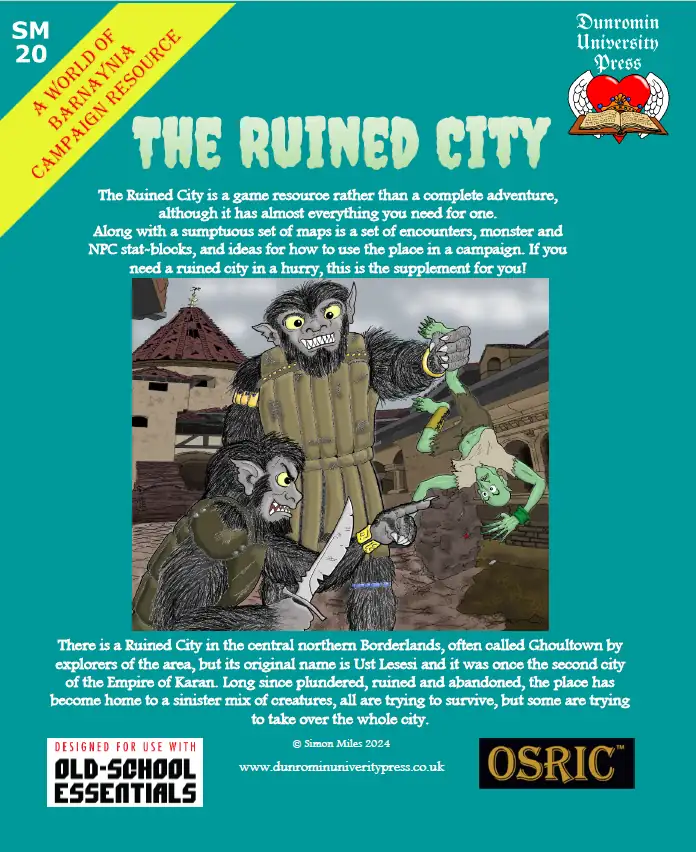
There is a Ruined City in the central northern Borderlands, often called Ghoultown by explorers of the area, but its original name is Ust Lesesi and it was once the second city of the Empire of Karan. Long since plundered, ruined and abandoned, the place has become home to a sinister mix of creatures, some are trading with each other, some are resting between skirmishes, all are schiming and all of them are trying to survive. This is a toy box for the GM - there are three settings in one - the Abandoned City, with stange creatures wandering the streets; the Monstrous community with several significant and detailed NPCs and their followers all trading, quarrelling and trying to get along with each other; and the city of the (un)dead - there's a whole army hidden in here, what are they being prepared for? The Ruined City is a 40-page game resource rather than a complete adventure, although it has almost everything you need for a simple hack or a more complex web of intrigue. Along with a sumptuous set of maps is a set of encounters, monster and NPC stat-blocks, and ideas for how to use the place in a campaign. If you need a ruined city in a hurry, this is the supplement for you! The Ruined City is designed for OSR but is also compatible with AD&D 1st and 2nd edition and pretty much any TTFRPG you fancy. The encounters are all pretty high level but most of the encounters will not be immediately hostile. There is scope in this setting for far more than simple hack and slash. These resources allow you to build a set of encounters as complex as you like. You can simply try and hack your way through, but there are some VERY nasty encounters in here. You could maybe set up your own base here, or just try and take over an existing group. Perhaps you want to start up a trade route, or maybe even start a Civil War! All of these possibilities, and many others, are catered for here. SM20 The Ruined City is released by Dunromin University Press. We are a very small publisher based in the UK and our aim is to produce VERY high quality products as the best value possible.
Dead from Above is intended for use with four to six player characters of levels 6 to 8. It will likely take two game sessions to complete. The adventure is set in (and above) a hilly region at the outskirts of civilization, presumably one near the base of a mountain chain. With a little work, the GM can place Dead from Above wherever he or she desires in the campaign world.

God of Ore is a 3rd-level adventure that takes the characters from the quiet, mountainside town of Miners’ Refuge into the heart of the Stoneheart Mountains in pursuit of a failed pilgrimage to discover a phony religious relic deep inside legendary Mithral Mountain. The dark, twisting tunnels that bore into the fabled mountain soon reveal that some mysteries are not what they first appear to be.

All the children of the Blight know the nursery rhymes about Bloody Jack Carver, cautionary tales for naughty or overly inquisitive children to mind their manners and obey their parents. However, their parents know the true horror of those times 30 years ago when the lunatic serial killer known as Bloody Jack Carver stalked the fog-shrouded streets of the Blight and abducted children. The killing spree finally ended, but the perpetrator was never caught. When the PCs are deputized to assist in a homicide investigation, they find terrifying clues that point to the three-decade-old Bloody Jack killings and signs to indicate that they were just the beginning. Now the PCs are in a race against time across the breadth of the decrepit and deteriorating city that is the Blight as they attempt to stop a new killing spree before it can start. The PCs’ investigation takes them from the halls of the Capitol and the seedy streets and alleys of Toiltown to the garish carnival piers of Festival and the pollutant-crusted banks of the Great Lyme River. Only they stand between the children of this decayed city and new nursery rhymes being written in their blood. Bloody Jack is a stand-alone adventure set in the Blight for 4–5 5th-level characters.

The greatness of a dwarven citadel is measured by its greatness of wealth. The dwarves steadily work mines and forges to fuel the wealth needed to make their presence known throughout the realms. Unfortunately, this also makes them known to those that would seek the opportunity to steal their glory and riches. This story occurs in a place that has experienced this struggle for millennia. New threats emerge as old threats become rivals through the tides of time. This story... your story... is another chapter of this ancient struggle.
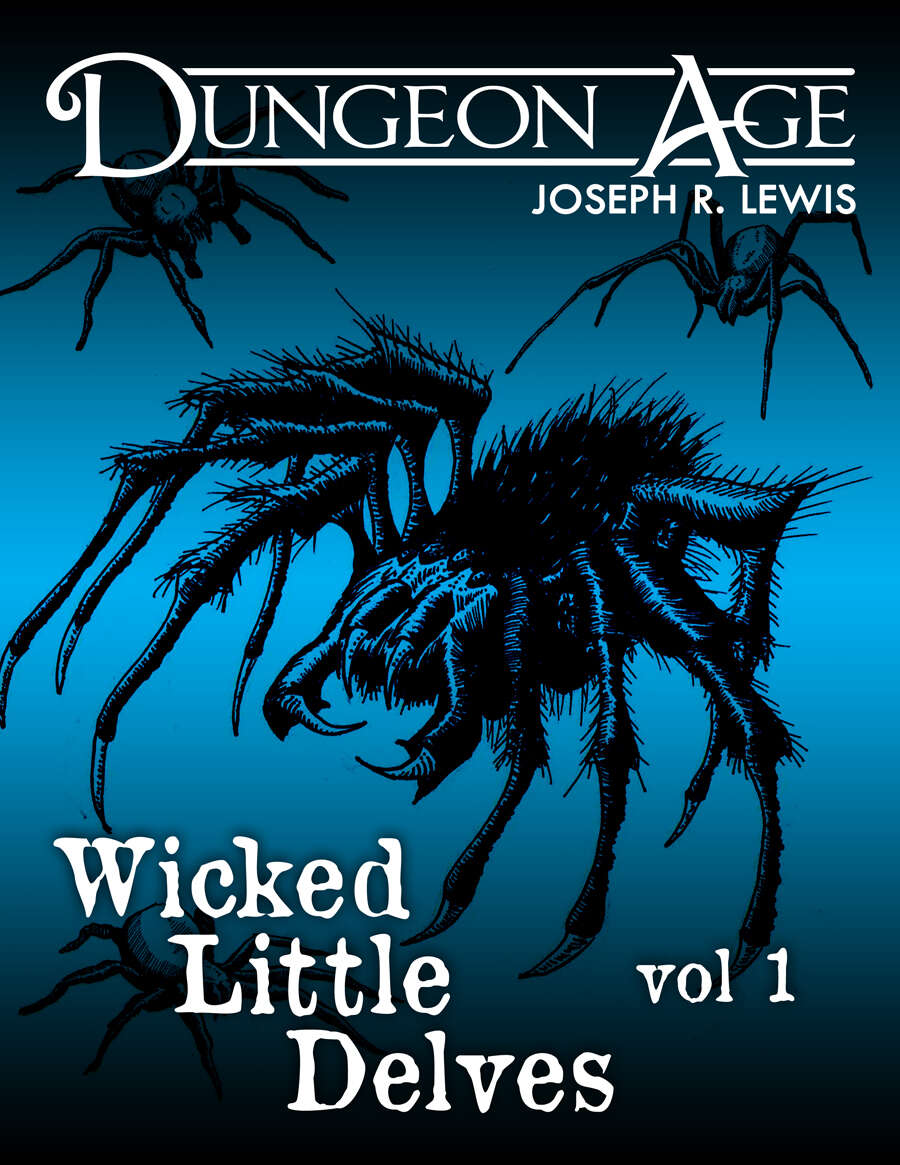
These are three one-shot dungeon delves. Each delve features nine rooms or locations full of challenges and interactivity. Each delve has only one type of monster, but they are complex, and there are lots of them! This volume of Wicked Little Delves includes three small dungeon adventures: - a new twist on the classic spiders-in-the-cellar, - a prison full of attack dogs, and - an abandoned cult lair full of pirate treasure and killer crabs. SYSTEM: Each monster has stats for Fifth Edition, Old School Essentials, and Into the Odd. These adventures are intended for characters at levels 1, 2, and 3. They are mainly focused on exploration and combat, with some minor social encounters. Estimated run time for each: 1 session, or 2-5 hours. Each adventure includes one complex original monster and a variety of unique treasures. ADVENTURE TYPE: Low Level / Combat / Exploration / One-Shot / Dungeon Delve
Quests of Doom Volume 2: 6 MORE Adventures for Fifth Edition Rules, First Edition Feel! For Quests of Doom Volume 1, we brought in some of the biggest stars in adventure-writing history to produce 12 mindbogglingly insidious adventures for Fifth Edition. This is volume 2, containing six more explorations into “doom or glory” for your players. Once again, the all-star cast of authors delivers what we strive to give you: Adventures Worth Winning! Volume 2 of Quests of Doom contains 6 adventures in 100 pages, byBill Webb (Of Ants & Men, Pit of Despair, Isle of Eliphaz), Matt Finch (Perils of Ghostwind Pass), Jim Ward (Dread Dragon Temple), Michael Curtis (The Darkening of Namjan Forest), and Casey Christofferson (Pit of Despair).