When the fires smoldered in the belly of an ancient red dragon tyrant, and his thirst had been slaked by the blood of countless innocents, the old wyrm made a deal with a succubus to spawn him a son and ensure his name would live forever. The demon held true, though she imbued the wyrmling with her own infernal blood. Those who fear and serve the abominable spawn of this pact know him as the Wyrm Prince. Cast into the abyss centuries ago by the legendary Three- River Paladin, the Wyrm Prince licked his wounds and recovered his strength. The Three-River Paladin has passed into legend, and the Wyrm Prince has resurfaced, his vengeance awakened along with his hunger. The Wyrm Prince sacked the high city Zhaldanis, slaying its people and claiming the greatest gift from the gods — the Soulstone. At this late hour, you must venture into the catacombs of the Wyrm Prince before the Soulstone loses its power and all mortal souls are damned.

Guilds Town is in the middle of Dravens, a province of the realm of Shrave. 50 years ago, the neighboring dwarven province of Kiernard rebelled and tried to overthrow the green dragon Shrave who rules the realm. They failed and their province was dissolved. Dwarves who left the province mostly fled to Dravens, and are called Nards as both a racial slur and a stigma of their people’s dishonor. Guilds Town are the ones really in control of the province and are the current opposition of the Dravens nobility. In recent times, corruption and crime in the city have risen to new heights as 4 cults compete for control of the city and their citizens. Published by NaturalCrit
Ra’s Evil Grin challenges adventurers of at least 11th level who are seeking a powerful magic item—the globe of Arden. If a different item suits your campaign better, another appropriate powerful item can be substituted as the final objective. This dungeon culminates in a battle with Dendorandra, a lesser marilith known as a dark daughter. As a lead-in to this adventure, the GM may use a map from another treasure hoard showing the location of the globe (detailed more fully in “The Legend of the Globe of Arden,” below) or a priestly tome describing Arden, the long-dead avatar of Ra, and the wondrous powers of an unknown artifact called the globe of Arden. Such a tome might mention that the globe emits rays as intense as those of the sun, destroying all they touch. In any event, characters should need to consult with sages and oracles to determine the location and history of the globe and dungeon. A sage could also provide a map to the dungeon’s location, referenced in the “The Legend of the Globe of Arden,” below. We set the dungeon on a small, remote island far across the sea, but you can relocate it to suit your campaign. This dungeon provides numerous puzzles, a few traps, and only two monsters. Those monsters, though few in number, should challenge and threaten even the most combat-hardened party—particularly after the party encounters all the vicious creatures that inhabit the Island of the Globe.
The Dungeon of Graves, is nothing more and nothing less than a good, old–fashioned, First Edition dungeon crawl updated for the 5th Edition Roleplaying Game. Very difficult, it should strike fear into the hearts of the most stalwart adventurers. It offers an abundance of traps, tricks, and monsters. We hope that you find this module as fun and exciting as those thousands of players who have ventured into (and not as often out of) the endless caverns and mazes of Rappan Athuk—The Dungeon of Graves. Rappan Athuk is a difficult dungeon. Even the upper dungeon levels should not be attempted by a party of less than six mid-level characters.
The ancient world of Harth withers beneath its dying sun…but it’s not dead yet. High in the night sky, a vampire’s tower is torn apart by a rampaging angel. People and monsters are trapped. Magical treasure lies scattered everywhere. It’s all yours for the taking, if you can find a way out before the angel finds you. This adventure is a one-shot dungeon-delve into a wizard’s tower. In space. With vampires. This is an alien-survival-horror-movie of an adventure (or at least, you can choose to play it that way). ADVENTURE TYPE: One-Shot / Low Level / Level 3 / Dungeon Delve / Tower / Vampires / Survival-Horror DESIGN NOTES This adventure is intended for low-level characters (around level 3). It is focused mostly on exploration, with several social encounters and opportunities for deadly combat. It runs 3 to 5 hours. There are 17 unique magical items, 17 unique monsters, and 17 unique rooms. I swear I did not plan that, it just worked out this way.

This adventure has been designed as a one shot adventure for 4-8 players, pregen 5th level characters included, in 4-6 hours. It tells a classic story of the "good" races oppressing the "dark" races, with their warlike expansionist ways.
Characters track the kidnapped Evanna to a goblin outpost with a dungeon underneath. They must successfully infiltrate the stronghold to rescue her and get out, before the goblins can mount a counter offensive against them.

Ages ago, a religious order known as the Druun practiced rituals from inside sacred oak groves, ceremonial pools, and stone henges. In time, the Church of Law and Order suppressed the Druunic teachings, and the ancient holy sites were lost, forgotten, or converted to other uses. One such former site is located in the capital city of Dolmvay in the center of a small neighborhood known as Whiteoak Square. This neighborhood has recently been experiencing a strange phenomenon: At night, small dancing lights have been seen floating throughout the neighborhood. The residents were afraid of this sorcery at first, however, the lights seem to exude a feeling of peace and contentment, and the locals have grown used to them. How it Started: A few weeks ago, a butcher named Walton Brand was clearing out his cellar when he stumbled upon a secret underground passage that led to an ancient Druun hall. This hall was filled with lost relics, arcane lore, and forgotten treasures of the Druun. Walton told his friends, Loomis the Baker and the chandler Stefan of Walsbury, and the three men began sneaking away from their wives at night to dress in Druun finery and pretend to be men of wealth. A harlot named Red Kirsten was hired to attend them as they drank, feasted, and cavorted in the sacred hall. Unbeknownst to the revelers, the Druun hall still retained some of its magical powers and their merriment awakened the ancient guardian spirits of the grove. These creatures, known as faerlings, are the lights that have been seen dancing throughout the neighborhood. The faerlings were given life by the revelers' glee, and they project that joy and happiness onto the other residents of the neighborhood. This glee, however, is about to turn to horror. . . Oak Grove Whispers is a Labyrinth Lord™ adventure designed for 3-6 characters of 1st-3rd levels (about 10 levels total). The adventure is broken up into three chapters that take place in a small neighborhood located in the capital city of Dolmvay (the Labyrinth Lord is free to substitute any medium- to large-sized city from his own campaign world). Oak Grove Whispers involves a mixture of roleplaying, investigation, and dungeon crawling, so a diverse range of classes is recommended. As the adventure is set in a civilized city, the characters must also be careful their interaction with NPCs does not land them on the wrong side of the law. Published by Small Niche Games
Many years ago a brutal bugbear chieftain united the goblinoid tribes of the Meirlara Forest and nearly wiped out all traces of the elves there within. A stroke of chance fate turned the tide and the dreaded bugbear warlord Spragnokk was defeated. His loyal kin hid his body away in a sealed chamber and then the world forgot about Spragnokk... until now. Now his bloodline continues, and they have plans to resurrect their fallen "great chieftain," to bring ruin and revenge upon the elves that handed them defeat decades past. The goblinoid tribes have once more been gathered, and their bloody revenge is imminent, except fate has yet once more placed new champions to stand in their way. They just don't realize it yet.
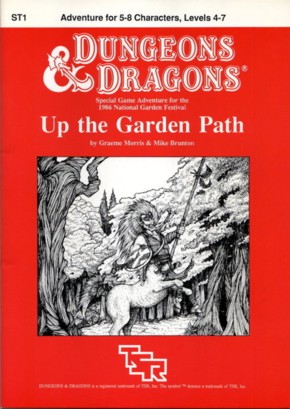
The day has been long and hard and, as night falls, you gratefully surrender to the soft, silent blackness of well-earned sleep. Then the dream comes. You are seated on a throne in a cavern where the sun has never shone; where no voice has ever spoken. Yet you are not alone. Through the darkness, silent figures are moving. Blacker than black... formless yet menacing... advancing towards you from every side... You fell their touch; icy claws plucking at your skin and hair, lifting the throne and carrying you helpless on a journey from darkness into further darkness, from silence into deeper silence. You scream, and a million anguished, reedy voices answer your call. Suddenly you awake... ... and the dream is real. A module printed exclusively in the United Kingdom by TSR UK. Using the 1986 National Garden Festival as its theme, this module was sold both at that festival, and at the 1986 Games Day RPG convention at the Royal Horticultural Society Hall in London (hosted by Games Workshop that Saturday, September 27th). It was briefly mentioned in White Dwarf magazine 82, page 49.

Punjar: wide-eyed madmen stalk the streets pronouncing the end of days, mail-clad priests crush the skulls of heathens underfoot, and timorous virgins are offered up in sacrifice within sooty temples. But even the greatest of shining temples and the strangest of mystery cults don’t dare to challenge the terrifying finality of Death. Until now. In Blades Against Death, the adventurers cross between the realms of the living and the dead, and wager their souls in a desperate bid to steal a soul from Death’s hoary grasp. To win over the God of Dooms, you must be the most daring, stalwart and cunning and – when all else fails – willing to test your blades against Death! A mid-level adventure for the Dungeon Crawl Classics Role Playing Game, Blades against Death offers characters a once in a lifetime escapade. Those that return from the Realms of the Dead will have earned the true title of adventurer, while those that fail will spend eternity in Death’s service.

An original Valentine's Day-themed one-shot adventure designed for level 4-5 characters. SUMMARY The city of St. Valentine is home to Dante's Casa di Dolci, a world-renowned bakery — and tucked within the bakery is the entrance to a secret labyrinth, created by a mischievous, merciless god. Every February, an unsuspecting resident from St. Valentine is pulled into the maze. Some return after years spent in the labyrinth, but most do not. When Dante's beloved wife, Simonetta, is pulled into the labyrinth, he must enlist the help of adventurers to get her back. The journey that follows is one of strange doors, riddles, and dangerous creatures that lurk among the hedges... DETAILS 2-4 hour session for 3-6 players Play-tested material Original NPCs and locations Diagrams and NPC stats 19-page campaign guide Enjoy the adventure? Share your experiences with me! Hashtag: #LabyrinthOfThorns
The Pyramid of Amra is a challenging adventure designed for characters of at least 12th level. Due to the nature and numbers of undead enemies (vampires), having a cleric on hand with the ability to cast raise dead and greater restoration is advisable. The PCs should be rounded out with a wizard or sorcerer and a pair of front-line fighters. In this adventure, the PCs travel to the Pyramid of Amra and the ancient Monastery of Night, where they face one of the most dangerous of opponents they are likely to meet, C’nosretep the Champion of Set.
Ancient port city on the edge of a desert. The city is stratified by social class and some of the slaves have formed a cannibal cult to Kthulhu. City + hexcrawl + dungeon. The Anthropophagi of Xambaala™ takes players into an action-packed realm of adventure: the mythical world of Hyperborea, a sword-and-sorcery campaign setting inspired by the fantastic fiction of Robert E. Howard, H.P. Lovecraft, Clark Ashton Smith, and others. This adventure is inspired by Robert E. Howard’s “The Man-Eaters of Zamboula” and by various short tales of H.P. Lovecraft and Clark Ashton Smith. It is designed for use with Astonishing Swordsmen & Sorcerers of Hyperborea ™(AS&SH™), a role-playing game descended from the original 1974 fantasy wargame and miniatures campaign rules as conceived by E. Gary Gygax and Dave Arneson. AS&SH is compatible with most traditional fantasy role-playing games (c. 1974 to 1999) and their modern simulacra, such as OSRIC™ and Swords & Wizardry™. This work is both a setting and an adventure. The setting describes the town of Xambaala, noting key people, locations, and local lore. The adventure proper provides players with a variety of environments and the several factions fighting over them for their own goals. With a bit of skill and luck, stalwart adventurers may emerge richer and maybe wiser. The situation that will develop in Xambaala will be determined by the players’ choices.
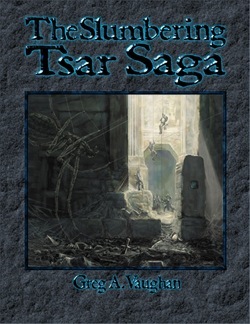
The Sleeper Awakes! At last, after languishing in its crypt for an age, the secrets of the slumbering city of Tsar burst forth in all their macabre glory. Poured forth from the eldritch furnaces and crucibles of the Necromancer and Orcus himself comes Frog God Games bringing you at long last The Slumbering Tsar Saga™. Something Stirs in the City of Evil Over the distant northern hills, beyond The Camp, and past the Desolation stand the pitted walls of Tsar. A hundred armies have crushed themselves against this bulwark in futile attempts to breach the city. Even the combined might of the Heavens and Earth were unable to break through in the final battle of Tsar. So why was the city suddenly abandoned on the verge of victory, and what waits for those foolish enough to enter the Temple-City of Orcus? The Black Gates Await Only the bravest and most powerful of heroes dare the depths of the Desolation and live to tell of it. But what happens when they penetrate that blasted landscape and look upon the gates of the very center of evil on the earth. Can even heroes of such renown breach the Walls of Death and live?
:strip_icc()/pic2633965.jpg)
Discovering a once-hidden passage in the Purple Planet’s Ancestor Peaks, the PCs enter the tomb of the Immortal Kahl. The party must survive deadly chambers fraught with alien life and technologies while unraveling the tomb’s mysteries. Ultimately, the party faces a choice unlike any encountered before, and a reward which will change them forever.
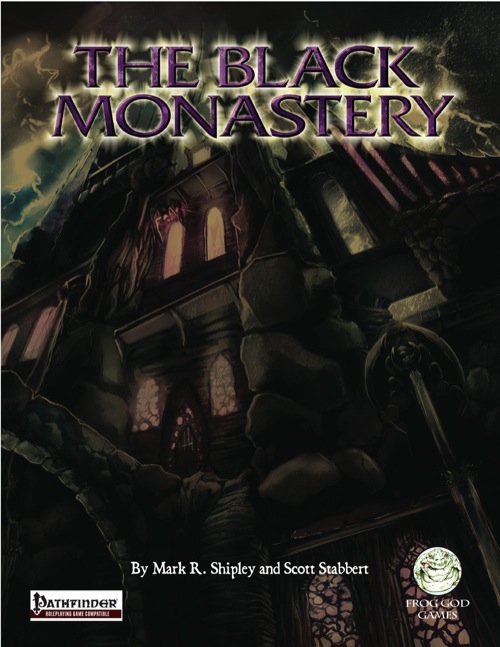
The Legend of the Black Monastery Two centuries have passed since the terrible events associated with the hideous cult known as the Black Brotherhood. Only scholars and story-tellers remember now how the kingdom was nearly laid to waste and the Black Monastery rose to grandeur and fell into haunted ruins. The Brothers first appeared as an order of benevolent priests and humble monks in black robes who followed a creed of kindness to the poor and service to the kingdom. Their rules called for humility and self denial. Other religious orders had no quarrel with their theology or their behavior. Their ranks grew as many commoners and nobles were drawn to the order by its good reputation. The first headquarters for the order was a campsite, located in a forest near the edge of the realm. The Brothers said that their poverty and dedication to service allowed them no resources for more grand accommodations. Members of the Black Brotherhood built chapels in caves or constructed small temples on common land near villages. They said that these rustic shrines allowed them to be near the people they served. Services held by the Brothers at these locations attracted large numbers of common people, who supported the Black Brotherhood with alms. Within 50 years of their first appearance, the Black Brotherhood had a number of larger temples and abbeys around the kingdom. Wealthy patrons endowed them with lands and buildings in order to buy favor and further the work of the Brothers. The lands they gained were slowly expanded as the order’s influence grew. Many merchants willed part of their fortunes to the Black Brotherhood, allowing the order to expand their work even further. The Brothers became bankers, loaning money and becoming partners in trade throughout the kingdom. Within 200 years of their founding, the order was wealthy and influential, with chapters throughout the kingdom and spreading into nearby realms. With their order well-established, the Black Brotherhood received royal permission to build a grand monastery in the hill country north of the kingdom’s center. Their abbot, a cousin of the king, asked for the royal grant of a specific hilltop called the Hill of Mornay. This hill was already crowned by ancient ruins that the monks proposed to clear away. Because it was land not wanted for agriculture, the king was happy to grant the request. He even donated money to build the monastery and encouraged others to contribute. With funds from around the realm, the Brothers completed their new monastery within a decade. It was a grand, sprawling edifice built of black stone and called the Black Monastery. From the very beginning, there were some who said that the Black Brotherhood was not what it seemed. There were always hints of corruption and moral lapses among the Brothers, but no more than any other religious order. There were some who told stories of greed, gluttony and depravity among the monks, but these tales did not weaken the order’s reputation during their early years. All of that changed with the construction of the Black Monastery. Within two decades of the Black Monastery’s completion, locals began to speak of troubling events there. Sometimes, Brothers made strange demands. They began to cheat farmers of their crops. They loaned money at ruinous rates, taking the property of anyone who could not pay. They pressured or even threatened wealthy patrons, extorting money in larger and larger amounts. Everywhere, the Black Brotherhood grew stronger, prouder and more aggressive. And there was more… People began to disappear. The farmers who worked the monastery lands reported that some people who went out at night, or who went off by themselves, did not return. It started with individuals…people without influential families…but soon the terror and loss spread to even to noble households. Some said that the people who disappeared had been taken into the Black Monastery, and the place slowly gained an evil reputation. Tenant farmers began moving away from the region, seeking safety at the loss of their fields. Slowly, even the king began to sense that the night was full of new terrors. Across the kingdom, reports began to come in telling of hauntings and the depredations of monsters. Flocks of dead birds fell from clear skies, onto villages and city streets. Fish died by thousands in their streams. Citizens reported stillborn babies and monstrous births. Crops failed. Fields were full of stunted plants. Crimes of all types grew common as incidents of madness spread everywhere. Word spread that the center of these dark portents was the Black Monastery, where many said the brothers practiced necromancy and human sacrifice. It was feared that the Black Brotherhood no longer worshipped gods of light and had turned to the service of the Dark God. These terrors came to a head when the Black Brotherhood dared to threaten the king himself. Realizing his peril, the king moved to dispossess and disband the Black Brother hood. He ordered their shrines, abbeys and lands seized. He had Brothers arrested for real and imagined crimes. He also ordered investigations into the Black Monastery and the order’s highest ranking members. The Black Brotherhood did not go quietly. Conflict between the order and the crown broke into violence when the Brothers incited their followers to riot across the kingdom. There were disturbances everywhere, including several attempts to assassinate the king by blades and by dark sorcery. It became clear to everyone that the Black Brotherhood was far more than just another religious order. Once knives were drawn, the conflict grew into open war between the crown and the Brothers. The Black Brotherhood had exceeded their grasp. Their followers were crushed in the streets by mounted knights. Brothers were rounded up and arrested. Many of them were executed. Armed supporters of the Black Brotherhood, backed by arcane and divine magic, were defeated and slaughtered. The Brothers were driven back to their final hilltop fortress – the Black Monastery. They were besieged by the king’s army, trapped and waiting for the king’s forces to break in and end the war. The final assault on the Black Monastery ended in victory and disaster. The king’s army took the hilltop, driving the last of the black-robed monks into the monastery itself. The soldiers were met by more than just men. There were monsters and fiends defending the monastery. There was a terrible slaughter on both sides. In many places the dead rose up to fight again. The battle continued from afternoon into night, lit by flames and magical energy. The Black Monastery was never actually taken. The king’s forces drove the last of their foul enemies back inside the monastery gates. Battering rams and war machines were hauled up the hill to crush their way inside. But before the king’s men could take the final stronghold, the Black Brotherhood immolated themselves in magical fire. Green flames roared up from the monastery, engulfing many of the king’s men as well. As survivors watched, the Black Monastery burned away, stones, gates, towers and all. There was a lurid green flare that lit the countryside. There was a scream of torment from a thousand human voices. There was a roar of falling masonry and splitting wood. Smoke and dust obscured the hilltop. The Black Monastery collapsed in upon itself and disappeared. Only ashes drifted down where the great structure had stood. All that was left of the Black Monastery was its foundations and debris-choked dungeons cut into the stones beneath. The war was over. The Black Brotherhood was destroyed. But the Black Monastery was not gone forever. Over nearly two centuries since its destruction, the Black Monastery has returned from time to time to haunt the Hill of Mornay. Impossible as it seems, there have been at least five incidents in which witnesses have reported finding the Hill of Mornay once again crowned with black walls and slate-roofed towers. In every case, the manifestation of this revenant of the Black Monastery has been accompanied by widespread reports of madness, crime and social unrest in the kingdom. Sometimes, the monastery has appeared only for a night. The last two times, the monastery reappeared atop the hill for as long as three months…each appearance longer than the first. There are tales of adventurers daring to enter the Black Monastery. Some went to look for treasure. Others went to battle whatever evil still lived inside. There are stories of lucky and brave explorers who have survived the horrors, returning with riches from the fabled hordes of the Black Brotherhood. It is enough to drive men mad with greed – enough to lure more each time to dare to enter the Black Monastery.

Lurking in the drowning folly that is the aristocratic enclave of the Sinks, the horrific Asylum, shunned by a citizenry terrified of the revelations it may contain, is where the nobles of the Blight bury their living secrets. But when too many overseers are killed, and in ways more gruesome than even the brutality of that location might evoke, someone must enter to investigate. Those who do soon learn that life — if it can be called that within its walls of that bleak place — is even worse than they feared and the truths that nestle within its inmates are far more distressing than mere madness.
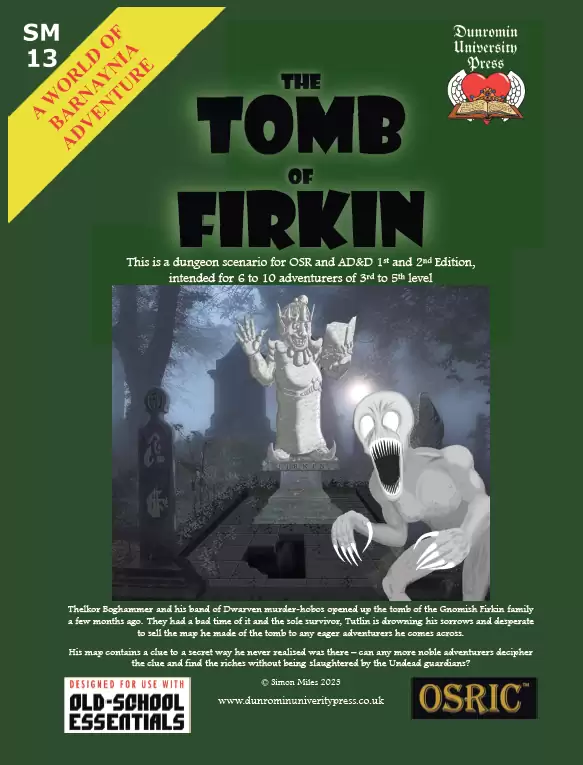
The Tomb of Firkin is a challenging and varied Dungeon Tomb-Raid from Dunromin University Press Designed for 6 to 10 adventurers of 3rd to 5thlevel, this is a Tomb dungeon scenario with a more to it than just Undead. Suitable for any OSR flavour and 1st and 2nd Edition D&D. Thelkor Boghammer and his band of Dwarven murder-hobos opened up the tomb of the Gnomish Firkin family a few months ago. They had a bad time of it and the sole survivor, Tutlin, is drowning his sorrows and desperate to sell the map he made of the tomb to any eager adventurers he comes across. His map contains a clue to a secret way he never realised was there – can any more noble adventurers decipher the clue and find the riches without being slaughtered by the Undead guardians? Or, failing that, could your characters do it? ;-) The Tomb of Firkin is more than just another tomb; hidden in the depths are a humanoid tribe and a secret cult based on geometry. The adventure is 44 pages with quality maps and illustrations to help you visualise the encounters. The style is based on minimal set-up, total carnage, maximum fun - the Tomb of Firkin would also work as SOLO PLAY! SM13 The Tomb of Firkin is available in pdf, softback or hardback Print On Demand at amazing value for such a quality product! But the best quality playing aids at the best possible prices is what we do at Dunromin University Press...

Yesterday, young Tobias went to investigate an old tomb by himself. Everyone told him it was a bad idea. Everyone was right. Today, you and your companions awaken to a town in chaos. Why is the temple sealed behind a divine shield? Why are children and worshippers trapped within? How do we get inside? What did Tobias do?! Ragged Hollow is a full-service starting town, full of classic creatures and challenges all updated and brought together for newbies and nostalgia-lovers alike. There are goblins and witches in the woods, a house full of traps, a basement of vermin, kobolds in a cave, bandits on the road, riddling ravens, a 50-room temple dungeon, nursery-rhyme monsters, living nightmares, Lovecraftian horrors, and tons of unique items to find. This is a mystery with lots of relevant side-quests around the town. The heroes can investigate the situation, get into the temple, save the innocents, and stop the monsters. And get some loot! ADVENTURE TYPE: Medium Dungeon / Town / Wilderness Adventure DESIGN NOTES This adventure is intended for characters levels 1 to 4. It includes several wilderness areas (forest, hills, mountain), a bustling town, several local mini-dungeons, and one 50-room temple dungeon. Each area contains various encounters and unique items. There are many opportunities for combat, but it is possible for players to explore most areas and complete many interactions without any combat at all, depending on their choices. INCLUDES: Story hooks, dialogue prompts, random encounters, stat blocks, original creatures and treasures, and maps. KEYWORDS: town, village, forest, goblins, goblin market, witches, hags, hills, bandits, ogres, mountain, kobolds, caves, dwarves, temple, clerics, nightmares, demons, riddles, traps, ghosts, fairy tales, Lovecraft, mutant