
A dungeon of tricky puzzles, ancient magical secrets, and more than a few lingering mysteries, designed to be played as a standalone adventure and not incorporated into another campaign. Six adventurers descend into the Temple of Mysteries to find a mystical artifact called the Strand of Tears. Seems straightforward enough, except that some of the party may not be who they say they are. In fact, none of the party may be who they say they are. Not only that, but they might not be who they don't say they are, either! Worst of all, they're trapped in the ruins of an underground temple specifically designed to keep people from proceeding unless they're proficient in puzzle-solving...and there may be doppelgangers on the loose.
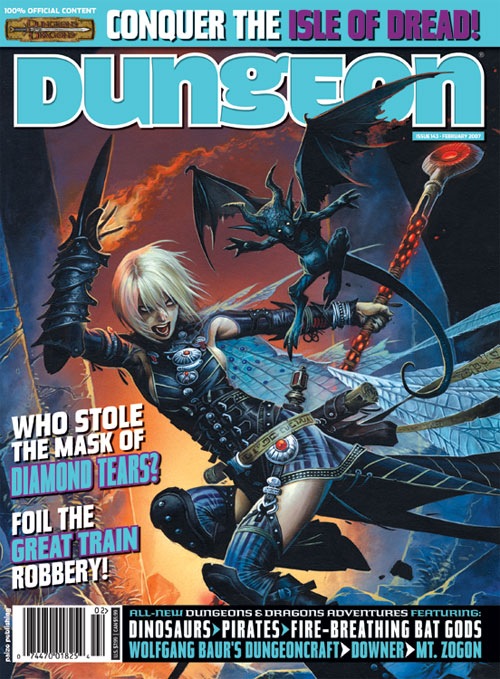
The colony of Farshore has survived on its own for years, a secluded and struggling hamlet perched on the western shore of the tiny island of Temute. An island dwarfed by the savage landscape across the narrow channel to the north, a landscape of rugged mountains, tangled jungles, and trackless swamps. This is the Isle of Dread, and its resources and hidden treasures are matched only by its peril. Yet for all these dangers, what may bring doom to Farshore is not an invasion of inhuman monsters from the mainland, but an invasion of all-too-human monsters from across the sea. "Tides of Dread" is the fifth chapter of the Savage Tides Adventure Path, a complete campaign consisting of 12 adventures appearing in Dungeon magazine. For additional aid in running this campaign, check out Dragon magazine's monthly "Savage Tidings" articles, a series that helps players and DMs prepare for and expand upon the campaign. Issue #352 of Dragon magazine features rumors of Farshore, a helpful list of improvements the PCs can make to the colony, and other features to help get PCs oriented in their new home on the Isle of Dread. The destruction of a pirate ship signals the beginning of a Crimson Fleet invasion. The PCs must race against time to prepare for the onslaught before an old enemy can release another savage tide. Pgs. 28-59 Also see Pgs. 60-71 Backdrop: Farshore City of Hope.

Picking up where Chapter 33: Adventures in the Ptolus book leaves off, the adventures in The Night of Dissolution cover an arc that pits player characters against the darkest foes the city of Ptolus has ever faced. Following the threads of a hidden conspiracy, the characters find themselves up against insane cultists, wild chaos magic, and horrors from the primordial days of the world. This adventure book is laced with urban intrigue, high action, and even some dungeon exploration. Some highlights include: A description of Pythoness House, a haunted oracle/brothel that hides a trove of weapons vital in the fight against the Cults of Chaos. A huge secret temple of chaos where insidious fanatics worship the dreaded Galchutt. Details of a city-wide network of covert spies and agents that extends even into the highest echelons of Ptolus’ elite society. These adventures culminate in the player characters’ attempt to stave off the Night of Dissolution, a dark time long foretold when the slumbering Galchutt will awaken in their hidden lairs deep below the city—and bring catastrophe and woe to the world. Published by Malhavoc Press

After resupplying equipment, health, and morale, you have heard of a job opportunity available at a nearby pub. After first missing out on the chance, your fortunes change and get the job. After boarding the Gnome airship, the “Marietta”, you head off across the sea to locate the captain’s missing brother. You find out you will be going into the jungles of the lost Pula Noa tribe. Rumor and legend surround these natives as having streets and buildings paved in gold, silver, and death! This adventure setting was designed for 5th Edition rules D&D for the Filbar Campaign for mid-level adventurers and DM. This adventure is easily adaptable to most any game and system. Save yourself some time and utilize it for a one shot adventure or a continuing campaign!

Encounters in the Savage Underdark is a 150-page supplement containing mini-adventures, NPCs, locations, and magic items,from eighteen of the DMsGuild's best authors.This incredible 150 page supplement features 24 amazing new Underdark adventures. Visit Annarei's Garden Encounter an insane aboleth Interact with traveling merchants Attend the Fire Fest Perform an Underdark heist and so much more....
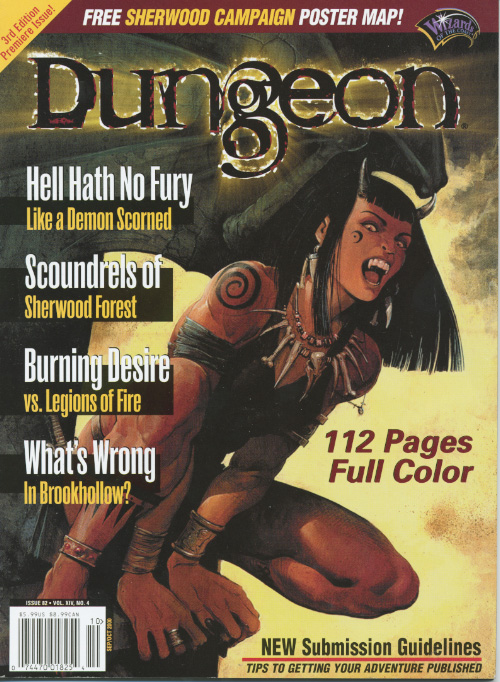
Digging in the Dark People are vanishing from the village of Brookhollow. Can you solve the mystery in time to save your friends? Pgs. 12-29
/pic1572963.png)
For over a thousand years the things that lurk beneath the waters, skulk in the darkness and lie hungrily in dank crypts have been patient, while all around them men and monsters bicker amongst themselves, bold enough to traverse the dark caverns' depths but afraid or perhaps wise enough to leave the forgotten vaults and hidden passages alone. Beneath the lost ruins of ancient Thracia lie the vast caverns of a once great civilization. While a death cult rules the surface, the Minotaur King and his beast men lurk fall below. Descend even deeper into the darkness and discover a lost and arcane world that waits for those brave enough to enter! Necromancer Games and Judges Guild have teamed up to expand and update the classic module Coverns of Thracia for 3.5. Designed for characters of 3rd to 8th level and higher, the Caverns of Thracia is a mini-campaign setting that presents intricate plots and exciting adventures.
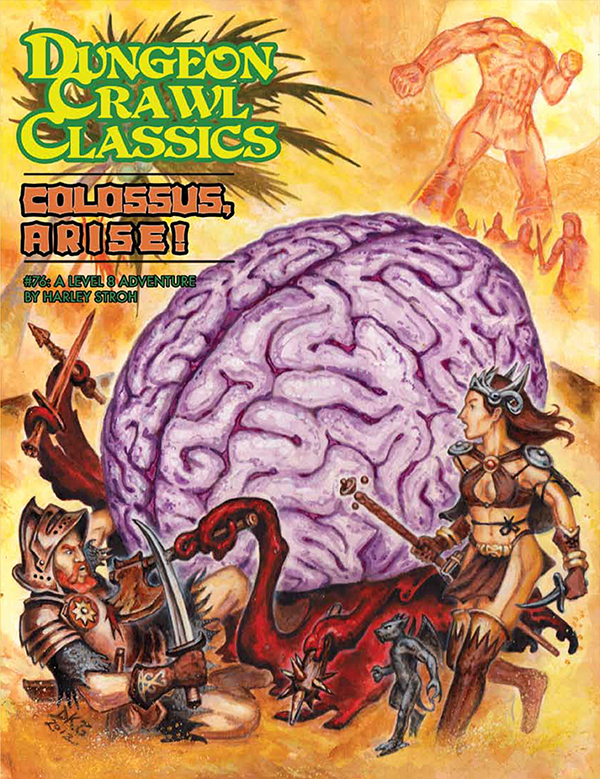
Giants stalk the shifting sands as the lost city of Stylos awakens from its deathless slumber. The Fourth Age of Man is at hand! All that stands between the gigantic hordes of Stylos and their conquest of the world is your band of adventurers. Sinister traps, implacable foes, and the crushing tread of the dread Colossus all lurk within these pages, eager to test the courage and cunning of even the most accomplished adventurers.
An adventure for 3-4 characters of Levels 3-4 exploring a ruined temple in a deep forest, with new monsters, new magic items, and all new original art. Deep within the Forest of Legressia lies a ruined temple of a long forgotten goddess. This ancient, crumbling temple is rumored to contain an artifact of the faith deep within its bowels, but also to be guarded by a shadowy malevolence. Your party has been tasked with reconnoitering the temple and retrieving the artifact. Great rewards await those courageous (or foolish) enough to delve into the Shadowed Temple of the Forgotten Goddess... https://www.drivethrurpg.com/product/475049/OSR-One-Shot--Shadowed-Temple-of-the-Forgotten-Goddess?src=hottest_filtered The adventure includes: 5 fully fleshed out encounters within the temple. Traps, monsters, riddles, and mysteries abound Four new monsters, two of which are variants of the shadow-bound Umbrathi, charged as guardians of the temple's secrets Harvesting and crafting options, for defeated and destroyed foes A new magical item, the Amulet of Redemption Lore connected with the world, including tie-ins to adventures to come A professional battlemap/sitemap from the superb Silver Compass Maps Incredible orginal artwork from Simon Underwood and Carlos Castilho Map Pack: includes gridded and ungridded versions of both GM maps and player friendly maps. Also includes VTT compatible maps

The End of the World Is at Hand! A hideous death cult has seized control of an ancient artifact-monument known as Tovag Baragu. The power behind the cult is the Old One himself, Iuz the Evil, demonic master of an empire. He's on an all-or-nothing quest for supremacy over the world—and the heavens beyond. To stop him, heroes must face horrors never dreamed of, journeying to a shadowed city where Death rules and the living cower. Here, Iuz will achieve his mad dream by destroying the imprisoned master of that alien citadel: Vecna, the mightiest lich, an immortal demigod. Two items exist with the power to stop Iuz—the Eye and the Hand of Vecna—but using them carries fantastic risks. Not even the gods know what will be unleashed when these items are fully activated. Die Vecna Die! takes the heroes from the Greyhawk campaign to the demiplane of Ravenloft and then to the Planescape city of Sigil. However, none of the material from those settings is required for play. TSR 11662

A small valley in the Basalt Mountains is home to a small farming community and a priory for the deity Enyndeth. Here young acolytes study to be full-fledged clerics of their faith. The priory was built into the side of one of the mountains when the community specialized in mining. This town should be able to provide road weary adventurers a reprieve from problems….or will it?

Turnover is upon us once again! Compete against rival adventuring groups to collect as many hidden, magical eggs as possible! Although the egg hunt begins within the relatively safe confines of Leilon, players will inevitably need to range further if they hope to win the competition. Tired of watching your children have the time of their lives hunting for magic eggs while your inner dragonborn barbarian stews and simmers on the sidelines? Well, thanks to An Egghunter's Guide to Adventure they no longer have to! This adventure supplement is much more than a full length adventure! It is a source of inspiration and template for how you can incorporate an egg hunt into any pre-existing campaign. It is the frolicsome spirit of Easter painstakingly updated to fifth edition standards!

Lorena Appleton, the youngest daughter of the youngest son of the heir to the Appleton estates, went missing several weeks ago and returned with a mysterious illness. Her parents spent their vast fortune pleading to all doctors and clerics passing through their town of Braeburn, desperate to find a cure for their daughter. Several healers have said that they couldn’t cure her without knowing what caused the ailment, but Lorena hasn’t said a word since she fell ill. The story piqued the interest of Syvil Loganberry, an elderly Halfling Cleric from the nearby city of Brackenshire. But the roads between Brackenshire and Braeburn have become wild in the last century, and all manners of forest creatures have turned vicious against those who dare brave the roads. The upcoming harvest festival in Braeburn has increased security along the roads, but Syvil grew old by being careful and has hired your band of adventurers to keep him safe as he made the journey. The three days of travel go by without an incident, but those familiar with the woods may wish otherwise. The forest has been still, silent, without even so much as a bird’s song to keep you company. It’s as if the forest itself is waiting...
Do you want to run or play an adventure where characters start at level 13 instead of ending at level 13, and actually get to progress to 20 like the rules say they should? Do your players like to travel far and wide, exploring a huge unknown area? Do your players like to change their plans on a whim, and travel somewhere other than where they told you they planned to go last session? Do your players feel like fighting against an empire at odds of 20,000 to 1? Do your players want to commit occasional acts of sky piracy? Do you want an adventure that is designed to handle players using Scrying, Transport Via Plants, and Teleportation on a daily basis? If you answered yes to some of these questions, this adventure may be for you. Check out the detailed preview packet, which includes a campaign log showing how this adventure has actually played out. WARNING: FULL OF SPOILERS; VERY LONG. Against the Idol of the Sun is an epic hexcrawl campaign designed for high-level play. Adventuring parties should start at about level 13, and will likely end the campaign at level 20 with multiple Epic Boons. As a hexcrawl, there is no set adventure path that the party must follow. There is only one encounter that's even close to plot-mandatory aside from the climactic battle. Anything else can be skipped or handled in any order. The players are free to move about the map in any direction at any time, limited only by the risk of enemy action and encounters. The DM, meanwhile, is encouraged to have foes react to and actively hunt the PCs once they become a threat. Along the way, they may find and explore a number of dungeons, including a millenia-old laboratory in the grips of a time distortion, several mines that were abandoned for good reason yet may hold wealth within, and other challenges appropriate for high-level characters. This module is heavy on Exploration and Combat, but the Social aspect of D&D also is necessary as the player characters meet new peoples, work to convince them that they can make a difference, motivate them to action, and create overall plans for the NPCs and factions to follow off-screen to support the players in their main assaults. The key set piece encounters, which are optional but highly probable, involve attacking well-defended temples in the centers of enemy cities. Planning for these attacks will require paying attention to reconnaissance, timing, the use of allies, how to enter, and how to exit and break contact succesfully when dealing with enemies that fly faster than most player characters can walk. The adventure does not include artwork, and the maps are basic.
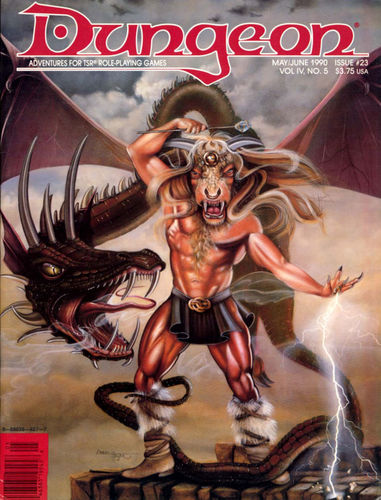
Looks can lie as well as words. Magical minotaurs? Mutant giants? Vampires? One or more of these is preying upon the caravans, and you're going to stop them. A band of ogre magi took over an abandoned dwarven stronghold and have started ambushing merchant caravans. Their leader, Krugii, wants to gain enough power to eventually control a kingdom. In his quest for power, he has bonded a young bronze dragon and has accelerated its growth. The ogre mages all have different personalities and different forms that they prefer to polymorph into. The PCs are hired to take a caravan through Deception Pass and protect it against the random monsters that have been marauding lately (actually ogre mages in disguise). After protecting the caravan, the players track the attacks back to the stronghold of the ogre magi and clear it out. Pgs. 40-62

The Blood of a King The king is dead. All hail the king! The nomadic cattle-herding tribes of Shoma now meet at the Horns of Ngura to sacrifice gold and choose a new tribal king based on a series of ritual ordeals. Will you sneak into the temple of the Bull-God to steal its treasures, or will you participate as a champion in the Trials of Ngura? Savage Swords and Sinister Sorcery "The Trials of Ngura" is a stand-alone sword and sorcery adventure module, inspired by the pulp era tales of Robert E. Howard and Clark Ashton Smith. Venture in the footsteps of Conan the Cimmerian, Satampra Zeiros of Uzuldaroum, Imaro of Nyumbani, and other fabled thieves, reavers and slayers! Written for the Fifth Edition (5E) of the world's most popular roleplaying game, the adventure in this book can be easily adapted to any fantasy roleplaying game ruleset or edition.
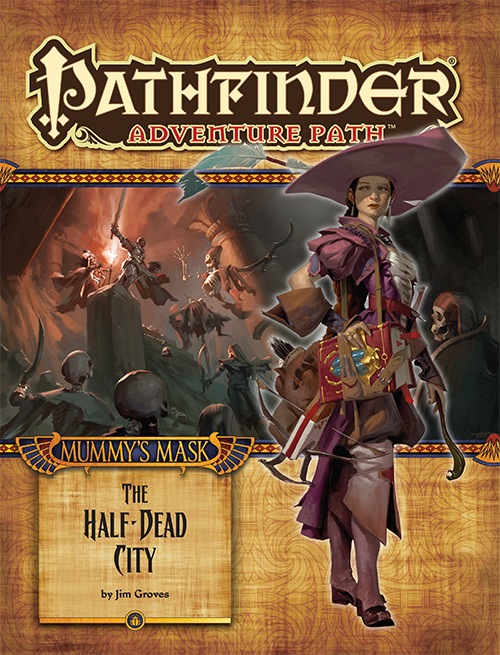
The Mummy's Mask Adventure Path begins with "The Half-Dead City," an exciting new adventure in the pyramid-laden realm of Osirion, Land of Pharaohs! In the city of Wati, the church of Pharasma holds a lottery allowing explorers to delve the tombs of the city's vast necropolis in search of the nation's lost glories. In the course of investigating dusty tombs and fighting their ancient guardians and devious traps, the heroes encounter a group of rival adventurers intent on keeping one tomb's treasures for themselves. At the same time, the heroes learn that a dangerous artifact has been stolen from the tomb. Can the adventurers defeat their rivals, or will they fall to the undead defenders of the city's necropolis?

A group of orcs has decided to start ambushing travellers on a forest road between two prosperous towns. Led by the enigmatic "Big Man" these orcs focus on robbing people, but tend to avoid violence. When the characters stumble upon this band of orcs robbing a halfling, do they give up their money to save him? Or risk the halfling's life to attack these bandits?

The small town of Boldon, and its surrounding villages are afraid. Dozens of people are missing, some speculate lost to some nefarious purpose. A broken drunkard tells fantastic tales of an evil temple and the horrible things within. The rare few who know the legends and history of the region are beginning to think the dark times have returned; not seen since the fall of the first age of man. People are beginning to feel the icy fingers of fear closing in. The party becomes aware of these events, and is inspired to investigate. This leads them to a broken man who tells them a story of a lost temple. Has it been rediscovered by men seduced by its forgotten evil? The drunkard’s tale leads to others who might help the party discover more before they face The Lost Temple of Forgotten Evil. Published by Fat Goblin Games
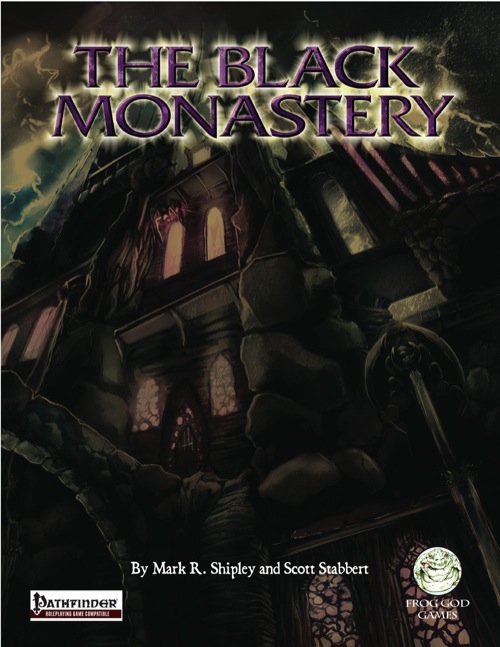
The Legend of the Black Monastery Two centuries have passed since the terrible events associated with the hideous cult known as the Black Brotherhood. Only scholars and story-tellers remember now how the kingdom was nearly laid to waste and the Black Monastery rose to grandeur and fell into haunted ruins. The Brothers first appeared as an order of benevolent priests and humble monks in black robes who followed a creed of kindness to the poor and service to the kingdom. Their rules called for humility and self denial. Other religious orders had no quarrel with their theology or their behavior. Their ranks grew as many commoners and nobles were drawn to the order by its good reputation. The first headquarters for the order was a campsite, located in a forest near the edge of the realm. The Brothers said that their poverty and dedication to service allowed them no resources for more grand accommodations. Members of the Black Brotherhood built chapels in caves or constructed small temples on common land near villages. They said that these rustic shrines allowed them to be near the people they served. Services held by the Brothers at these locations attracted large numbers of common people, who supported the Black Brotherhood with alms. Within 50 years of their first appearance, the Black Brotherhood had a number of larger temples and abbeys around the kingdom. Wealthy patrons endowed them with lands and buildings in order to buy favor and further the work of the Brothers. The lands they gained were slowly expanded as the order’s influence grew. Many merchants willed part of their fortunes to the Black Brotherhood, allowing the order to expand their work even further. The Brothers became bankers, loaning money and becoming partners in trade throughout the kingdom. Within 200 years of their founding, the order was wealthy and influential, with chapters throughout the kingdom and spreading into nearby realms. With their order well-established, the Black Brotherhood received royal permission to build a grand monastery in the hill country north of the kingdom’s center. Their abbot, a cousin of the king, asked for the royal grant of a specific hilltop called the Hill of Mornay. This hill was already crowned by ancient ruins that the monks proposed to clear away. Because it was land not wanted for agriculture, the king was happy to grant the request. He even donated money to build the monastery and encouraged others to contribute. With funds from around the realm, the Brothers completed their new monastery within a decade. It was a grand, sprawling edifice built of black stone and called the Black Monastery. From the very beginning, there were some who said that the Black Brotherhood was not what it seemed. There were always hints of corruption and moral lapses among the Brothers, but no more than any other religious order. There were some who told stories of greed, gluttony and depravity among the monks, but these tales did not weaken the order’s reputation during their early years. All of that changed with the construction of the Black Monastery. Within two decades of the Black Monastery’s completion, locals began to speak of troubling events there. Sometimes, Brothers made strange demands. They began to cheat farmers of their crops. They loaned money at ruinous rates, taking the property of anyone who could not pay. They pressured or even threatened wealthy patrons, extorting money in larger and larger amounts. Everywhere, the Black Brotherhood grew stronger, prouder and more aggressive. And there was more… People began to disappear. The farmers who worked the monastery lands reported that some people who went out at night, or who went off by themselves, did not return. It started with individuals…people without influential families…but soon the terror and loss spread to even to noble households. Some said that the people who disappeared had been taken into the Black Monastery, and the place slowly gained an evil reputation. Tenant farmers began moving away from the region, seeking safety at the loss of their fields. Slowly, even the king began to sense that the night was full of new terrors. Across the kingdom, reports began to come in telling of hauntings and the depredations of monsters. Flocks of dead birds fell from clear skies, onto villages and city streets. Fish died by thousands in their streams. Citizens reported stillborn babies and monstrous births. Crops failed. Fields were full of stunted plants. Crimes of all types grew common as incidents of madness spread everywhere. Word spread that the center of these dark portents was the Black Monastery, where many said the brothers practiced necromancy and human sacrifice. It was feared that the Black Brotherhood no longer worshipped gods of light and had turned to the service of the Dark God. These terrors came to a head when the Black Brotherhood dared to threaten the king himself. Realizing his peril, the king moved to dispossess and disband the Black Brother hood. He ordered their shrines, abbeys and lands seized. He had Brothers arrested for real and imagined crimes. He also ordered investigations into the Black Monastery and the order’s highest ranking members. The Black Brotherhood did not go quietly. Conflict between the order and the crown broke into violence when the Brothers incited their followers to riot across the kingdom. There were disturbances everywhere, including several attempts to assassinate the king by blades and by dark sorcery. It became clear to everyone that the Black Brotherhood was far more than just another religious order. Once knives were drawn, the conflict grew into open war between the crown and the Brothers. The Black Brotherhood had exceeded their grasp. Their followers were crushed in the streets by mounted knights. Brothers were rounded up and arrested. Many of them were executed. Armed supporters of the Black Brotherhood, backed by arcane and divine magic, were defeated and slaughtered. The Brothers were driven back to their final hilltop fortress – the Black Monastery. They were besieged by the king’s army, trapped and waiting for the king’s forces to break in and end the war. The final assault on the Black Monastery ended in victory and disaster. The king’s army took the hilltop, driving the last of the black-robed monks into the monastery itself. The soldiers were met by more than just men. There were monsters and fiends defending the monastery. There was a terrible slaughter on both sides. In many places the dead rose up to fight again. The battle continued from afternoon into night, lit by flames and magical energy. The Black Monastery was never actually taken. The king’s forces drove the last of their foul enemies back inside the monastery gates. Battering rams and war machines were hauled up the hill to crush their way inside. But before the king’s men could take the final stronghold, the Black Brotherhood immolated themselves in magical fire. Green flames roared up from the monastery, engulfing many of the king’s men as well. As survivors watched, the Black Monastery burned away, stones, gates, towers and all. There was a lurid green flare that lit the countryside. There was a scream of torment from a thousand human voices. There was a roar of falling masonry and splitting wood. Smoke and dust obscured the hilltop. The Black Monastery collapsed in upon itself and disappeared. Only ashes drifted down where the great structure had stood. All that was left of the Black Monastery was its foundations and debris-choked dungeons cut into the stones beneath. The war was over. The Black Brotherhood was destroyed. But the Black Monastery was not gone forever. Over nearly two centuries since its destruction, the Black Monastery has returned from time to time to haunt the Hill of Mornay. Impossible as it seems, there have been at least five incidents in which witnesses have reported finding the Hill of Mornay once again crowned with black walls and slate-roofed towers. In every case, the manifestation of this revenant of the Black Monastery has been accompanied by widespread reports of madness, crime and social unrest in the kingdom. Sometimes, the monastery has appeared only for a night. The last two times, the monastery reappeared atop the hill for as long as three months…each appearance longer than the first. There are tales of adventurers daring to enter the Black Monastery. Some went to look for treasure. Others went to battle whatever evil still lived inside. There are stories of lucky and brave explorers who have survived the horrors, returning with riches from the fabled hordes of the Black Brotherhood. It is enough to drive men mad with greed – enough to lure more each time to dare to enter the Black Monastery.