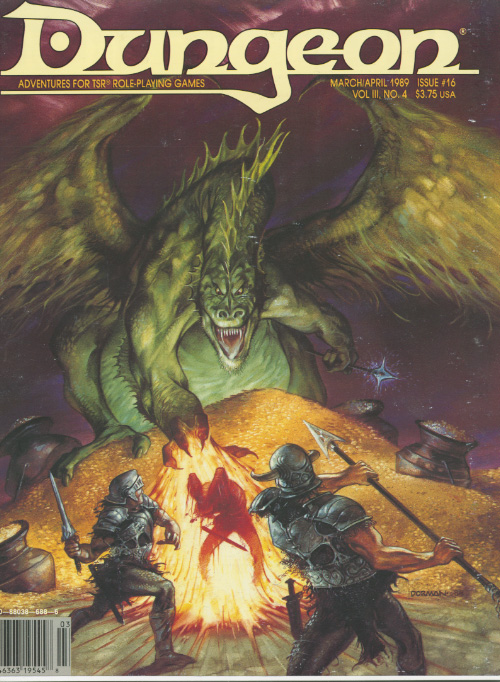
The giants are only a half-mile away - straight up. Giants and humanoids that sail down from the heavens? Where could they be coming from? No base town or general area map has been provided, as this adventure can take place anywhere and can be easily integrated into any existing campaign.The DM should make sure that the town in which the PCs start is large enough to provide most anticipated supplies, spells, and services. This module is not a simple hack·and slay expedition. It also involves diplomacy and wit; if the PCs attack everything in sight, they may be destroyed. But the adventure is not entirely negotiation, for it has a good share of hearty dungeon exploration as well. Pgs. 4-23
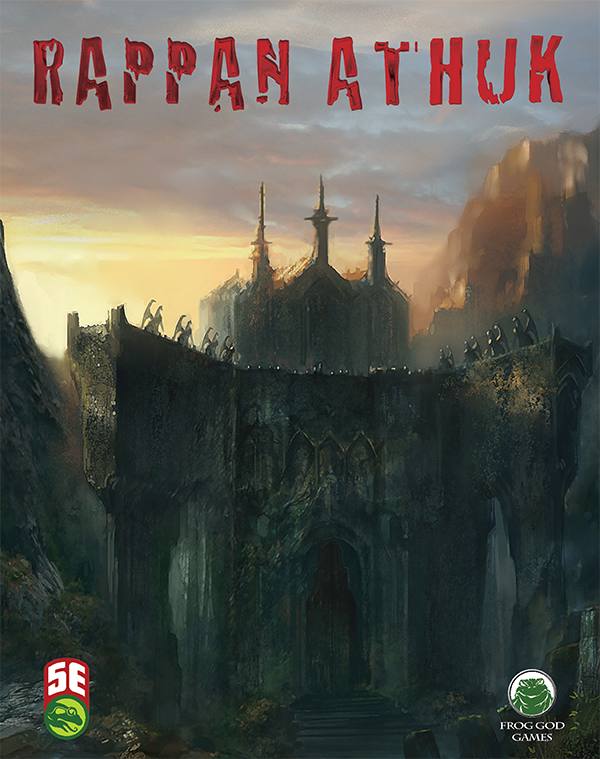
The Dungeon of Graves, is nothing more and nothing less than a good, old–fashioned, First Edition dungeon crawl updated for the 5th Edition Roleplaying Game. Very difficult, it should strike fear into the hearts of the most stalwart adventurers. It offers an abundance of traps, tricks, and monsters. We hope that you find this module as fun and exciting as those thousands of players who have ventured into (and not as often out of) the endless caverns and mazes of Rappan Athuk—The Dungeon of Graves. Rappan Athuk is a difficult dungeon. Even the upper dungeon levels should not be attempted by a party of less than six mid-level characters.
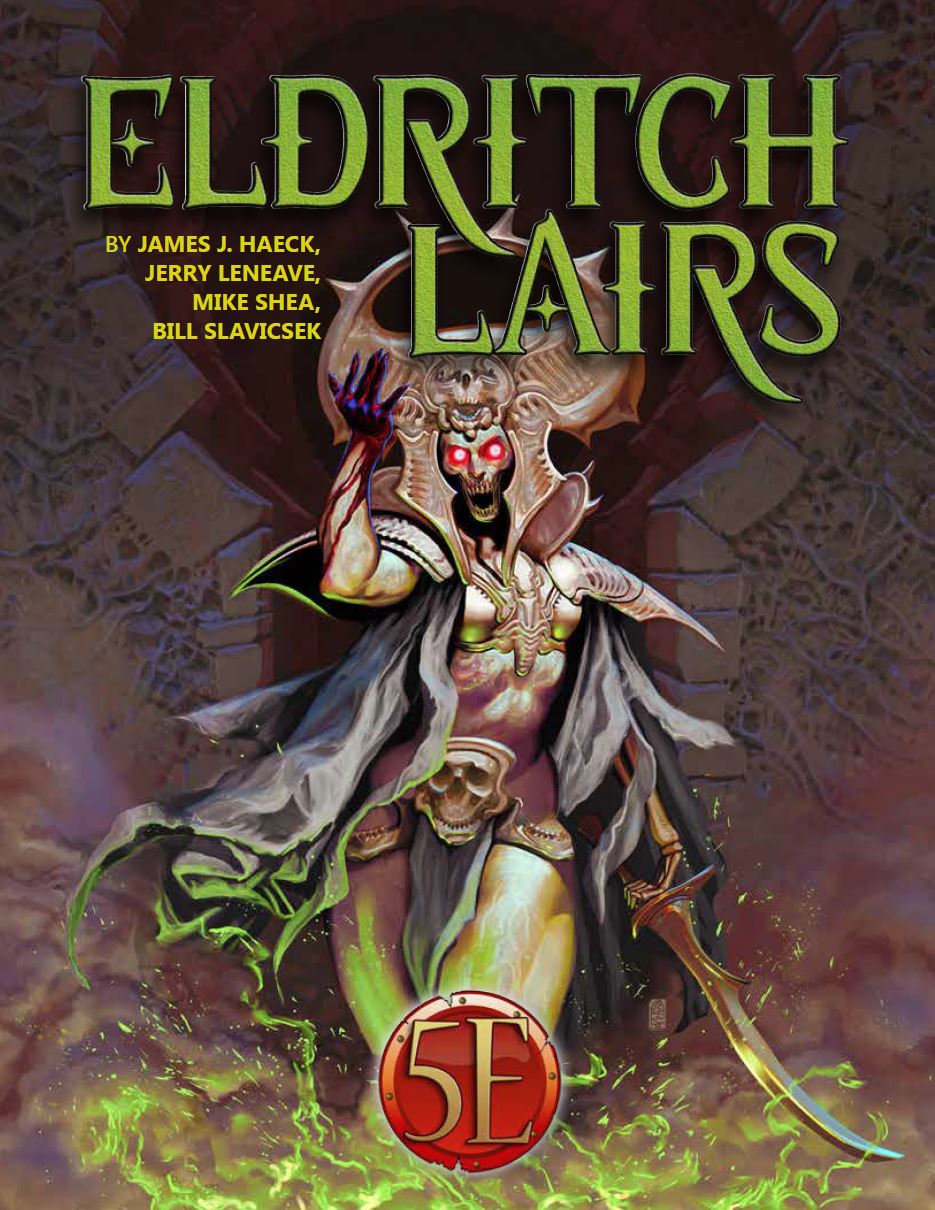
The people of Feycircle believed the fairy ring for which their town was named protected them from the encroaching sands of the Western Wastes. When the ring withered, they learned they were right. Feycircle’s dewflecked pastures and verdant forests succumbed to the Wastes in an instant. Feycircle sank deep into the sands and was soon occupied by a tribe of fanatical dust goblins, a herd of dogmoles, and the giant worms that caused the blight. The PCs may explore the keep—the only structure remaining in the dusty sinkhole now called the "Pit of the Dust Goblins." Inside the keep is an entrenched gatekeeper who can divulge that two children remain in town, imprisoned by the goblins. The dust goblins have summoned and imprisoned a selang—a shadow fey—inside the blighted fairy circle. The goblins fear open combat and have laced the sunken keep with traps, and would sooner parley than fight.
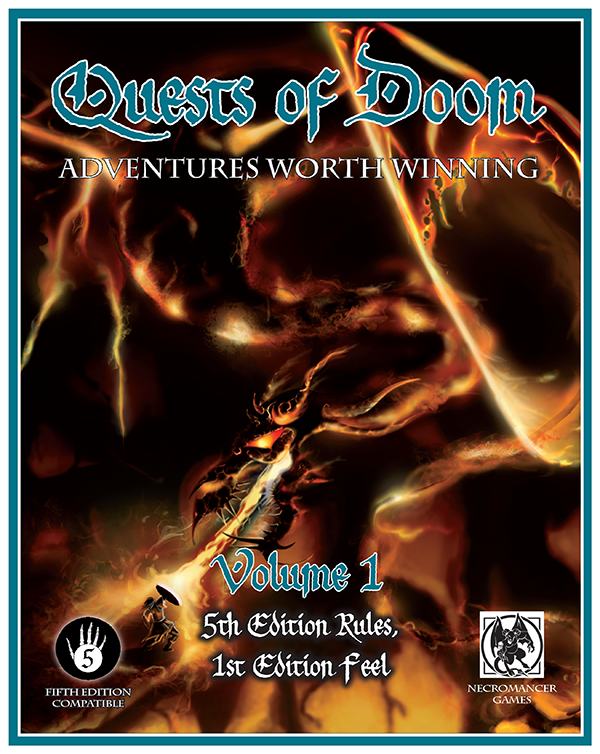
In ancient times, the area now known as the Dyrgalas Fens was home to a flourishing civilization of nature worshippers who wrested a living from the forest around them, built open-air temples, and generally did well. Over the centuries, a series of natural disasters (some say a series of foolish magical experiments) led to a rising water table and turned the forest into a vast swamp. As the water rose, most of the people left. Today, a few stalwart humans remain in the fens, living off the land through hunting, fishing, trapping, and even some agriculture. In addition to these honest folk, the Dyrgalas has some less savory residents, including both black and green dragons, trolls, hags, escaped criminals, and a host of lycanthropes. Most of these creatures prey on travelers foolish or unlucky enough to enter the fen, and sometimes raid both inside and outside the fen. This adventure, intended for characters of levels 6 to 8, deals with one group of raiders who make their lair in the Dyrgalas. A weretiger called Gavriil has formed a group of assorted lycanthropes into a band of cunning brigands. The lycanthropes favorite caper involves infiltrating a merchant caravan while posing as travelers, merchants, or swords for hire, then attacking it from within. Gavriil and his servants also take on kidnappings, murder for hire, and any other unsavory tasks that come their way.

You have no friends here What can you do when the Mists deposit you in the city of Lekar? The militia is no better than a gang of sadistic bullies, the citizens are more contagious than a fleet of plague ships, and every foot of public space is covered with corpses of criminals who committed no crime greater than struggling to survive in the oppressive domain of Falkovnia. Danger haunts your every move A secret society of assassins, known only as the Ebon Fold, has been hunting down visitors to Lekar and killing them in a most grisly fashion; all that remains of the victims are desiccated husks that crumble to ash when touched... and you are their next targets. There is no escape When everyone who has befriended you is either dead or hunted by the authorities, you have no choice but to fight back. But the Ebon Fold is a numberless horde whose leader holds sway over death. How can you defeat enemies that won't stay in the grave? They strike from the depths of darkness and steal your life... one dagger stroke at a time. This 64-page adventure can be played independently, or as the opening challenge in the Grim Harvest series that continues with Death Ascendant and concludes with Requiem. Inside the package is a poster map that fully details asll 10 levels of the chilling complex known as the Well of Bones. TSR 9523
Called by the Elder Elemental Eye to serve, four corrupt prophets have risen from the depths of anonymity to claim mighty weapons with direct links to the power of the elemental princes. Each of these prophets has assembled a cadre of cultists and creatures to serve them in the construction of four elemental temples of lethal design. It is up to adventurers from heroic factions such as the Emerald Enclave and the Order of the Gauntlet to discover where the true power of each prophet lay, and dismantle it before it comes boiling up to obliterate the Realms.
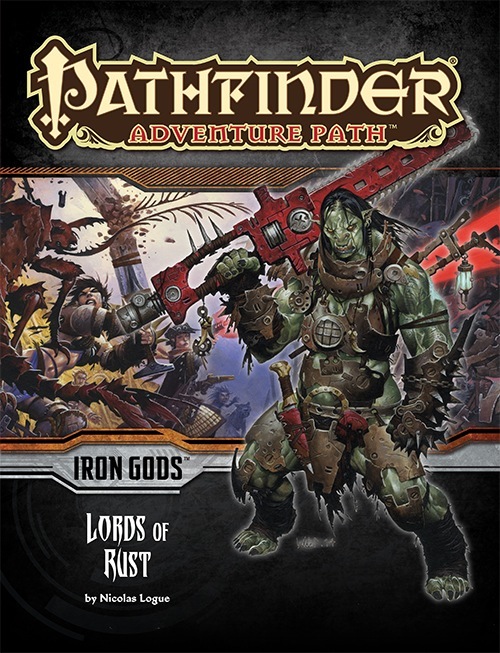
The heroes of the town of Torch follow a trail of clues to the sprawling junkyard known as Scrapwall, where bands of desperate and violent brigands vie for control of the technological remnants found within. The Lords of Rust dominate Scrapwall, and their swiftly rising power threatens more than just the town of Torch, for this gang has the support of one of the terrifying Gods of Numeria. What slumbers fitfully beneath the wreckage of Scrapwall could catapult the Lords of Rust into a new level of power if they're not stopped!

𝐂𝐨𝐫𝐚𝐥 𝐏𝐚𝐥𝐚𝐜𝐞 𝐨𝐟 𝐭𝐡𝐞 𝐌𝐚𝐫𝐢𝐝 𝐓𝐡𝐞 𝐒𝐞𝐜𝐨𝐧𝐝 𝐢𝐧 𝐚 𝐒𝐞𝐫𝐢𝐞𝐬 𝐨𝐟 𝐉𝐞𝐰𝐞𝐥 𝐇𝐞𝐢𝐬𝐭𝐬 𝐚𝐭 𝐭𝐡𝐞 𝐄𝐧𝐝 𝐨𝐟 𝐭𝐡𝐞 𝐌𝐮𝐥𝐭𝐢𝐯𝐞𝐫𝐬𝐞 Wherein our adventurers seek out the Emerald of Aquatic Perfection, reputed to be held within an extraplanar undersea genie basilica. 𝐀 𝐃&𝐃 𝟓𝐄 𝐚𝐝𝐯𝐞𝐧𝐭𝐮𝐫𝐞 𝐟𝐨𝐫 𝟒-𝟕 𝐜𝐡𝐚𝐫𝐚𝐜𝐭𝐞𝐫𝐬 𝐨𝐟 𝟏𝟐𝐭𝐡-𝟏𝟓𝐭𝐡 𝐥𝐞𝐯𝐞𝐥. 𝟒𝟎 𝐩𝐚𝐠𝐞𝐬.
The Assassin's Knot is a sequel to The Secret of Bone Hill, picking up on themes from that module and shifts them to a new locale. The player characters must solve the mystery of who killed the Baron of Restenford, with evidence pointing to somebody from the town of Garrotten. The scenario describes the town and its castle. The Assassin's Knot module is different from most of its contemporaries in that it contained no dungeon or dungeon-like area. The longer the players take to find the murderer, the more unfortunate events occur in the village. The village, Garrotten, is reputed to be the place to go to have someone killed. The entire village shuts down when the Baron of Restenford is found dead, mutilated beyond the possibility of magical restoration. Three small clues are all the player characters have to unravel the mystery. TSR 9057
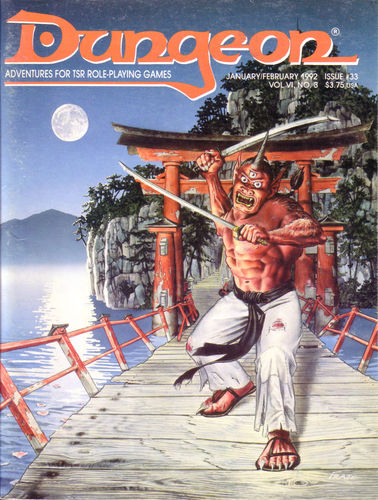
The orcs remember Tarran Kratys. Today he wishes they had not.
Reports of the owlbear incident were vastly exaggerated. When is an evil mage not an evil mage? While visiting the small village of Carthington Cross, the PCs hear a tale about a wizard who unleashed an owlbear on Carthington Cross and its unsuspecting community. After a night of stories and gossip in the local inn, the heroes are approached in the morning by this same notorious wizard who needs their help. Pgs. 18-28

The Adventurers arrive at a drow outpost in the Underdark. They must either dispose of the drow or ally with them against the invading legions of Orcus!

Stop evil cultists of the Crushing Wave. The party rescues a member of the Brotherhood of the Cloak in Mulmaster (local mage guild); Drayson Fivestar. Drayson asks them to investigate the murder of his colleague. After some urban investigation, the investigation leads to a former guard tower of the Zhentarim, now occupied by elemental cultists. The tower was submerged in mud, but recently uncovered. The party faces of with the cultists. (Large page count, but feasible as a one shot after some editing, will probably take two sessions at most)
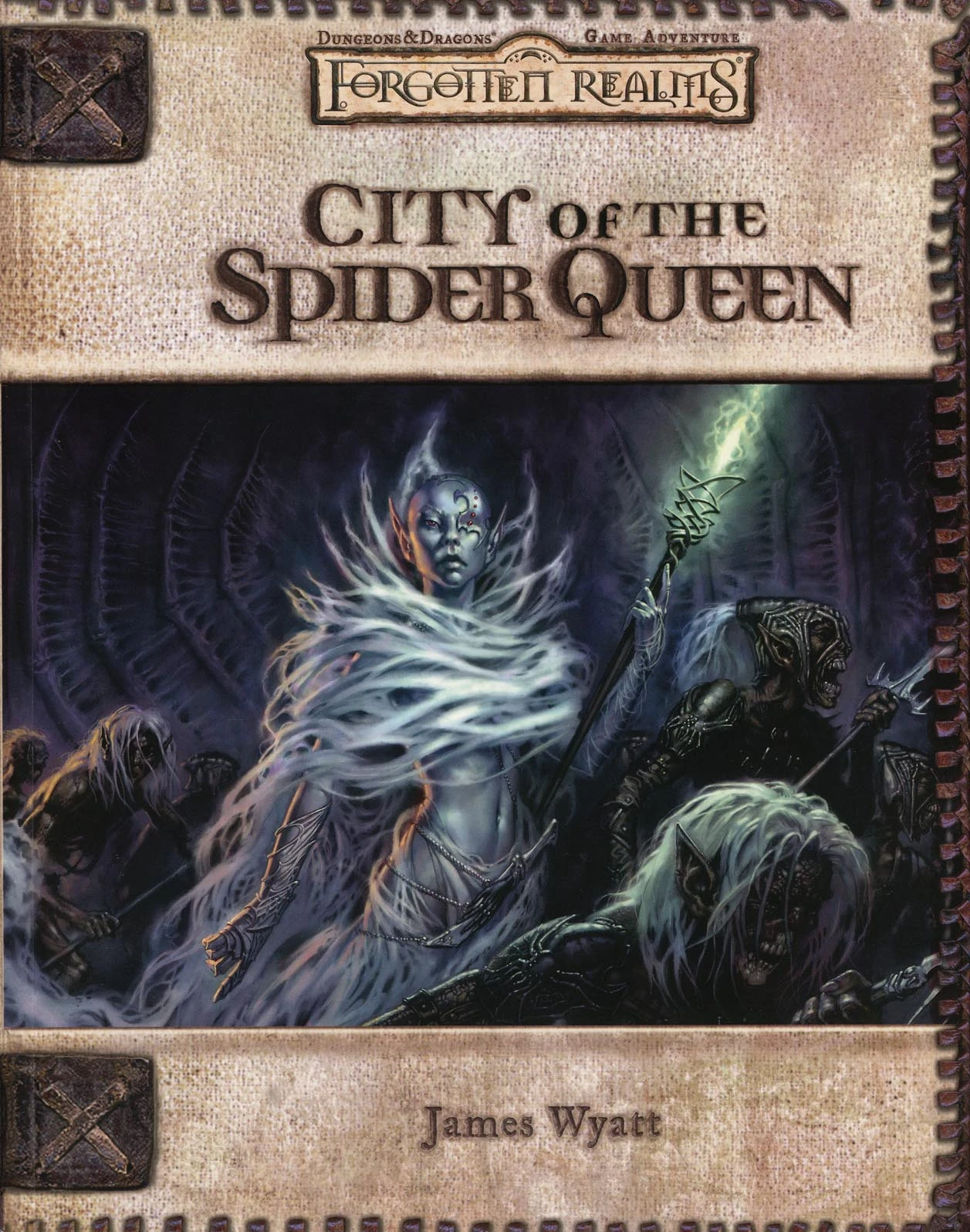
The Fate of Faerûn Lies in Shadowy Darkness! Daggerdale is reeling from a sudden series of murderous drow raids. As a grave threat to the entire surface world develops in the war-torn dark elf city of Maerimydra, intrepid heroes must discover its source and destroy it, if they can.

In this prelude to the full Princes of the Apocalypse campaign book, adventurers face off against the influence of Elemental Cultists in the hills and canyons of the Dessarin Valley. The four mini-adventures within are only tangentially related to each-other, and instead serve as starting points and hooks for the plots of the complete Princes of the Apocalypse Campaign. Players start in the well-described town of Red Larch; first investigating a local necromancer, then uncovering cult influences within the town, and finally heading off to infiltrate or do battle with two small elemental cultist strongholds. All parts of this adventure can serve as great places to seed hooks for other campaigns.

Deicide is a campaign designed to begin with a party of four to six 1st-level characters, who should advance to 20th level by its conclusion. The Gods have abandoned Faerûn. Bringing loved ones back from the dead hasn’t been done in centuries, and communion with the deities is a spiritual exercise only. Holy warriors and messengers have lost their powers and have all but completely disappeared. In this bleak world, wars are frequent, crime runs rampant, and hope has faded. Rumours are abound of a mysterious crime lord taking control of the underworld. Monsters roam the lands and every road is increasingly more dangerous. Without guidance, the many civilizations of this world are plagued by greed and corruption. The only way forward is to bring the Gods back, or to take their place in the heavens. Deicide takes place across two islands, Aurora and Limdorkal. These landmasses are the westernmost islands of the Moonshae Isles, an archipelago located roughly 400 miles west of the region of Amn and to the southwest of the Sword Coast. Surrounding the Sea of Moonshae, these islands feature a wide array of cities, civilizations, climates, terrains, and monsters. Limdorkal is famously a harsher environment, home to exotic races, whereas Aurora is almost entirely dominated by the human kingdom. Elminster Aumar, the famous Old Mage of Faerûn, once visited these islands and claimed it surprising how such diverse environmental systems erupted here, and how varied were the people inhabiting them. While the Sword Coast is part of Faerûn, a continent of Toril in the Forgotten Realms, feel free to adapt these islands to any setting of your choice, such as Ravenloft, Eberron, Ravnica, or even on your homebrew world. The story told here happens some hundreds of years after the beginning of 5th Edition, and the Overgod Ao is trapped inside an artifact, which limits the workings of gods around Toril. The characters will be able to learn more about the missing Gods, about a mythical folklore artifact known as the Wand of Wonders, which carries the powers of the Gods, and about the crime lord Kaiser Soze. Through their adventures, they will be able to visit other realms, planes, and dimensions, as well as come into contact with different races and civilizations. In the end, it is up to them whether to ally with the Crime Lord, and whether to release the Gods or keep their power for themselves. This campaign can work as a loose set of modular adventures, which can be easily picked separately and played as one-shots of different levels. Even their locations on the map might be moved, and events happening in particular towns can happen on others. The adventures include dungeon crawls, murder mysteries, sandbox urban quests, exploration on land and in the seas, inter-planar travelling, among others.

While the name Codic Keep used to have prestige associated with it in the past, it is now a crumbling fortress blasted years ago by a large tornado. Now the ruin sits next to a swamp and is pretty much left ignored. Recently word has reached Feastelburg that strange lights have been noticed near the keep and many have wondered if the wanted criminal relative has returned to reclaim the property. Wanted posters of “Si” Codic have been circulating for quite some time with a reward of 1500 gp for his capture. Who’s up for a swamp trip?

After having one adventure under your belts you set sail to deliver a package across the open seas. A problem with nature causes their vessel to make an unscheduled stop on a small island that was home to a spice dealer for water. Problems ensue on the island and the party quickly discovers they aren’t “feeling themselves”. This item was played at WhosYerCon convention this past year in Indianapolis!
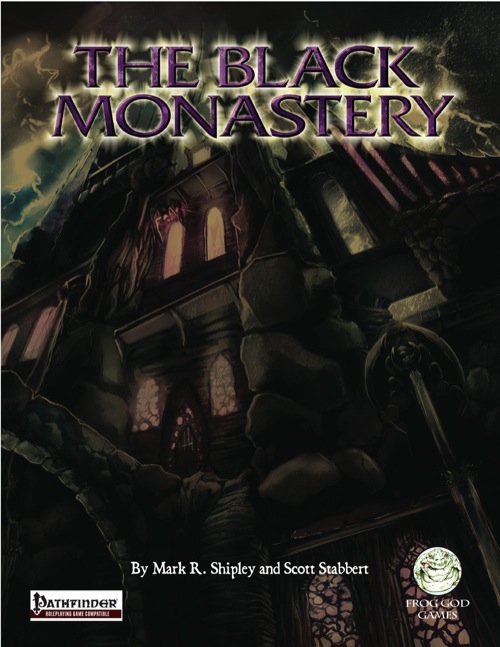
The Legend of the Black Monastery Two centuries have passed since the terrible events associated with the hideous cult known as the Black Brotherhood. Only scholars and story-tellers remember now how the kingdom was nearly laid to waste and the Black Monastery rose to grandeur and fell into haunted ruins. The Brothers first appeared as an order of benevolent priests and humble monks in black robes who followed a creed of kindness to the poor and service to the kingdom. Their rules called for humility and self denial. Other religious orders had no quarrel with their theology or their behavior. Their ranks grew as many commoners and nobles were drawn to the order by its good reputation. The first headquarters for the order was a campsite, located in a forest near the edge of the realm. The Brothers said that their poverty and dedication to service allowed them no resources for more grand accommodations. Members of the Black Brotherhood built chapels in caves or constructed small temples on common land near villages. They said that these rustic shrines allowed them to be near the people they served. Services held by the Brothers at these locations attracted large numbers of common people, who supported the Black Brotherhood with alms. Within 50 years of their first appearance, the Black Brotherhood had a number of larger temples and abbeys around the kingdom. Wealthy patrons endowed them with lands and buildings in order to buy favor and further the work of the Brothers. The lands they gained were slowly expanded as the order’s influence grew. Many merchants willed part of their fortunes to the Black Brotherhood, allowing the order to expand their work even further. The Brothers became bankers, loaning money and becoming partners in trade throughout the kingdom. Within 200 years of their founding, the order was wealthy and influential, with chapters throughout the kingdom and spreading into nearby realms. With their order well-established, the Black Brotherhood received royal permission to build a grand monastery in the hill country north of the kingdom’s center. Their abbot, a cousin of the king, asked for the royal grant of a specific hilltop called the Hill of Mornay. This hill was already crowned by ancient ruins that the monks proposed to clear away. Because it was land not wanted for agriculture, the king was happy to grant the request. He even donated money to build the monastery and encouraged others to contribute. With funds from around the realm, the Brothers completed their new monastery within a decade. It was a grand, sprawling edifice built of black stone and called the Black Monastery. From the very beginning, there were some who said that the Black Brotherhood was not what it seemed. There were always hints of corruption and moral lapses among the Brothers, but no more than any other religious order. There were some who told stories of greed, gluttony and depravity among the monks, but these tales did not weaken the order’s reputation during their early years. All of that changed with the construction of the Black Monastery. Within two decades of the Black Monastery’s completion, locals began to speak of troubling events there. Sometimes, Brothers made strange demands. They began to cheat farmers of their crops. They loaned money at ruinous rates, taking the property of anyone who could not pay. They pressured or even threatened wealthy patrons, extorting money in larger and larger amounts. Everywhere, the Black Brotherhood grew stronger, prouder and more aggressive. And there was more… People began to disappear. The farmers who worked the monastery lands reported that some people who went out at night, or who went off by themselves, did not return. It started with individuals…people without influential families…but soon the terror and loss spread to even to noble households. Some said that the people who disappeared had been taken into the Black Monastery, and the place slowly gained an evil reputation. Tenant farmers began moving away from the region, seeking safety at the loss of their fields. Slowly, even the king began to sense that the night was full of new terrors. Across the kingdom, reports began to come in telling of hauntings and the depredations of monsters. Flocks of dead birds fell from clear skies, onto villages and city streets. Fish died by thousands in their streams. Citizens reported stillborn babies and monstrous births. Crops failed. Fields were full of stunted plants. Crimes of all types grew common as incidents of madness spread everywhere. Word spread that the center of these dark portents was the Black Monastery, where many said the brothers practiced necromancy and human sacrifice. It was feared that the Black Brotherhood no longer worshipped gods of light and had turned to the service of the Dark God. These terrors came to a head when the Black Brotherhood dared to threaten the king himself. Realizing his peril, the king moved to dispossess and disband the Black Brother hood. He ordered their shrines, abbeys and lands seized. He had Brothers arrested for real and imagined crimes. He also ordered investigations into the Black Monastery and the order’s highest ranking members. The Black Brotherhood did not go quietly. Conflict between the order and the crown broke into violence when the Brothers incited their followers to riot across the kingdom. There were disturbances everywhere, including several attempts to assassinate the king by blades and by dark sorcery. It became clear to everyone that the Black Brotherhood was far more than just another religious order. Once knives were drawn, the conflict grew into open war between the crown and the Brothers. The Black Brotherhood had exceeded their grasp. Their followers were crushed in the streets by mounted knights. Brothers were rounded up and arrested. Many of them were executed. Armed supporters of the Black Brotherhood, backed by arcane and divine magic, were defeated and slaughtered. The Brothers were driven back to their final hilltop fortress – the Black Monastery. They were besieged by the king’s army, trapped and waiting for the king’s forces to break in and end the war. The final assault on the Black Monastery ended in victory and disaster. The king’s army took the hilltop, driving the last of the black-robed monks into the monastery itself. The soldiers were met by more than just men. There were monsters and fiends defending the monastery. There was a terrible slaughter on both sides. In many places the dead rose up to fight again. The battle continued from afternoon into night, lit by flames and magical energy. The Black Monastery was never actually taken. The king’s forces drove the last of their foul enemies back inside the monastery gates. Battering rams and war machines were hauled up the hill to crush their way inside. But before the king’s men could take the final stronghold, the Black Brotherhood immolated themselves in magical fire. Green flames roared up from the monastery, engulfing many of the king’s men as well. As survivors watched, the Black Monastery burned away, stones, gates, towers and all. There was a lurid green flare that lit the countryside. There was a scream of torment from a thousand human voices. There was a roar of falling masonry and splitting wood. Smoke and dust obscured the hilltop. The Black Monastery collapsed in upon itself and disappeared. Only ashes drifted down where the great structure had stood. All that was left of the Black Monastery was its foundations and debris-choked dungeons cut into the stones beneath. The war was over. The Black Brotherhood was destroyed. But the Black Monastery was not gone forever. Over nearly two centuries since its destruction, the Black Monastery has returned from time to time to haunt the Hill of Mornay. Impossible as it seems, there have been at least five incidents in which witnesses have reported finding the Hill of Mornay once again crowned with black walls and slate-roofed towers. In every case, the manifestation of this revenant of the Black Monastery has been accompanied by widespread reports of madness, crime and social unrest in the kingdom. Sometimes, the monastery has appeared only for a night. The last two times, the monastery reappeared atop the hill for as long as three months…each appearance longer than the first. There are tales of adventurers daring to enter the Black Monastery. Some went to look for treasure. Others went to battle whatever evil still lived inside. There are stories of lucky and brave explorers who have survived the horrors, returning with riches from the fabled hordes of the Black Brotherhood. It is enough to drive men mad with greed – enough to lure more each time to dare to enter the Black Monastery.
The lizard men are just pining for the fjords. A plague of locusts is bad enough, but when the locusts are each a yard long, the farmers need professional help! A swarm of giant locusts has been eating all the grapes and leaves from the vineyards of Vineyard Vale! In addition, lizard folk have attacked and destroyed several steads in the vale. The farmers are desperate, but what they don't know is that these events are linked! A mage known as Rhungold the Trickster has been orchestrating the attacks and locusts to try to scare the farmers off the land so he can claim it as his own. The players slowly piece the story together by investigating a fairly linear story through a cave, a marsh, and finally to a compound owned by the wizard Rhungold. Pgs. 6-16